


For twenty minutes in New York, Germany did something it had largely avoided since the war in Ukraine began: it spoke directly to Russia at foreign-minister level.
German Foreign Minister Johann Wadephul met Sergey Lavrov on the sidelines of the United Nations General Assembly, the first bilateral encounter between the two countries’ foreign ministers since January 2022. There was no breakthrough. No negotiating framework emerged. The Russian side said it heard nothing substantially new, while Berlin complained that Moscow showed little willingness to compromise.
Taken literally, it was an unsuccessful meeting. Politically, however, the fact that it happened is more significant than anything apparently said inside the room.
Germany has spent the past four years helping construct Europe’s policy of military support for Ukraine, economic sanctions against Russia and diplomatic isolation of Moscow. Berlin has not abandoned any of those policies. Yet Germany has now concluded that direct contact with Russia is again necessary.
That shift in method deserves attention. The question is not whether Germany has suddenly changed its position on the war. It has not. The question is why Berlin believes that the moment has arrived to reopen a channel it had allowed to remain effectively closed.
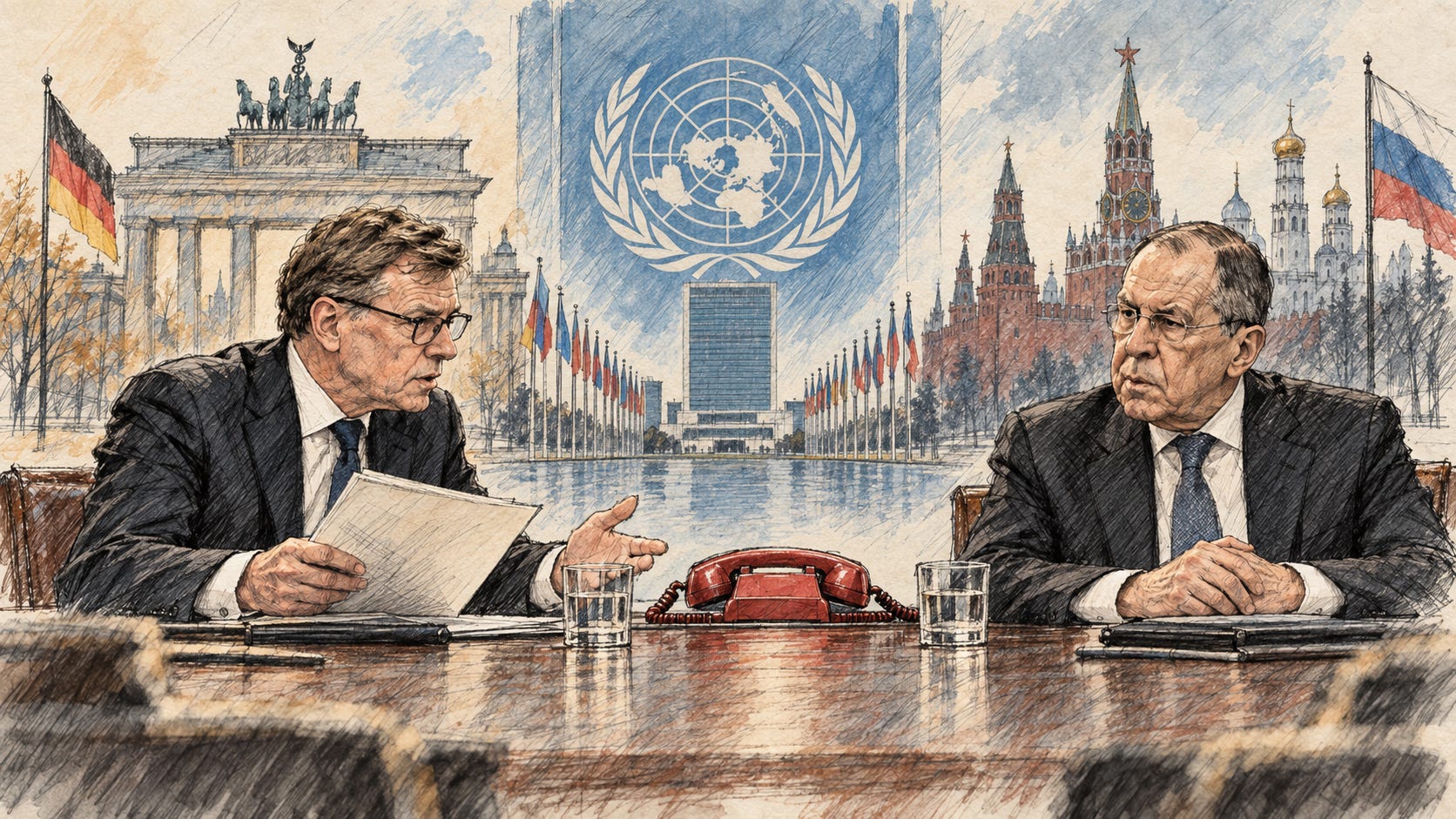
The Meeting That Was Not Supposed to Matter
The encounter itself was brief. Wadephul and Lavrov spoke for roughly twenty minutes. Russia said Germany requested the meeting. Wadephul gave a more complicated account, saying third countries had conveyed Moscow’s willingness to engage and encouraged Berlin to take the opportunity.
Even the dispute over who initiated the conversation is revealing. Neither side wants to appear to be the one seeking the other. For Moscow, that would risk suggesting that Western pressure is working. For Berlin, openly asking Russia for talks risks undermining a European political narrative built around the idea that Moscow must first demonstrate a change in behaviour.
Yet whatever diplomatic choreography preceded the meeting, both sides ultimately agreed to sit down. That alone breaks with the pattern of the past several years.
Wadephul used the meeting to press familiar German positions: a ceasefire, renewed negotiations and measures intended to reduce pressure on Ukraine, including discussion of Black Sea access and energy infrastructure. Lavrov appears to have offered little encouragement. That outcome should not have surprised Berlin. Russia currently has limited incentive to accept a ceasefire on European terms.
The Ceasefire Problem and Why Russia Has Little Incentive to Pause
The basic disagreement is not simply over whether the shooting should stop. It is over what a ceasefire is supposed to achieve. European governments generally present a ceasefire as the necessary first step toward diplomacy. Fighting stops, humanitarian and economic pressure decreases, negotiations follow and a broader political settlement becomes possible.
Moscow views the sequence differently. The Russian position has been that a ceasefire which leaves the underlying strategic dispute unresolved merely freezes the conflict. From that perspective, stopping military operations before agreement on territory, Ukrainian military capabilities, NATO involvement and the broader European security architecture would give Kyiv and its supporters time without requiring them to concede anything fundamental.
This is where the Minsk experience matters. It does not prove that Germany today is attempting to repeat 2015. But it shapes how Moscow interprets Western proposals. During the Debaltseve fighting, Angela Merkel and François Hollande accelerated their diplomacy as the military situation deteriorated for Ukraine. Minsk II followed.
The historical circumstances were different, but the strategic memory remains. Russian policymakers therefore have strong reasons to examine any European ceasefire proposal not simply as a peace initiative, but as a potential pause within a continuing confrontation. That is particularly true if Moscow believes the military balance is currently moving in its favour.
A ceasefire proposal carries far more weight when both sides believe continued fighting is becoming less attractive. That condition does not appear to exist today.
Russia continues to apply pressure along several sectors of the front while steadily expanding the range of infrastructure subjected to attack. Rail networks, energy systems, telecommunications facilities and other nodes supporting the Ukrainian state and war economy are increasingly part of the contest.
At the same time, Kyiv continues to face questions over manpower, financing, ammunition and the sustainability of its military effort. From Moscow’s perspective, stopping at this stage would therefore mean surrendering military pressure without first securing political concessions.
That is a difficult proposition to sell. This helps explain why Germany’s appeals appear to have produced so little response. Berlin is asking Russia to interrupt a strategy Moscow apparently believes is working. That does not make negotiations impossible. It does mean negotiations require more than appeals for restraint. For diplomacy to move, the parties would need to address the interests driving the conflict rather than merely its immediate military symptoms.
Join The Duran Community.
Subscribe and Support The Duran!
Berlin’s Contradiction
Germany’s position is particularly interesting because Berlin is attempting to pursue two policies at the same time. It is preparing for a prolonged confrontation with Russia while simultaneously reopening communication with Moscow. German defence spending is rising sharply. Berlin is expanding military capacity. German officials increasingly speak of Russia as a long-term security threat. Across Europe, political and military leaders openly discuss preparing for the possibility of a confrontation with Russia later this decade.
Moscow repeatedly points to those statements as evidence that Europe, rather than Russia, is institutionalising confrontation. Lavrov returned to that argument in New York. European governments accuse Russia of harbouring ambitions beyond Ukraine, he argued, while the same governments publicly discuss military readiness for a possible war with Russia by 2028, 2029 or 2030.
Berlin therefore faces an obvious strategic contradiction. Germany is preparing for the possibility that Russia will remain Europe’s principal military adversary while simultaneously recognising that some form of diplomatic relationship with Moscow is unavoidable. The Wadephul meeting is an early expression of that contradiction. Europe may want containment. It may want deterrence. It may want sanctions. But sooner or later, it also needs a negotiating channel.
Germany Cannot Outsource Diplomacy Forever
There is a wider European problem behind the meeting. For much of the war, Europe has effectively outsourced the most important diplomatic contacts with Moscow to Washington. European governments provided money, weapons, sanctions and political support while the United States retained the ability to communicate directly with the Kremlin when necessary. That arrangement becomes increasingly uncomfortable if Washington begins pursuing its own interests independently of Europe.
Germany, France and other major European states cannot permanently base their security policies on the assumption that the United States will negotiate with Russia on their behalf. Germany in particular cannot avoid this problem. It is Europe’s largest economy, one of Ukraine’s most important supporters and increasingly one of the continent’s central military powers. German-Russian relations are therefore not a secondary matter. They are part of the European security problem itself.
If Berlin wants arrangements covering energy infrastructure, Black Sea navigation, arms control, military escalation or eventually a wider settlement, Germany will eventually have to deal directly with Russia. The alternative is to remain dependent on decisions made elsewhere. The twenty-minute conversation in New York may therefore be less about an immediate ceasefire than about Germany cautiously rediscovering an old reality. Geography cannot be sanctioned away.
The Minsk Shadow
The temptation to compare the present moment with 2015 is understandable. Then, as now, battlefield pressure was accompanied by urgent European diplomacy. Then, as now, Germany found itself confronting the possibility that events on the ground were moving faster than European political strategy. But the differences are substantial.
The scale of the war is vastly larger. Russia’s military position is different. Ukraine’s dependence on Western assistance is deeper. European-Russian relations have deteriorated far beyond their condition a decade ago. Most importantly, Moscow’s assessment of Western diplomacy has changed. Russian officials repeatedly cite the Minsk agreements as evidence that temporary settlements can be used to buy military time rather than resolve underlying disputes. Whether European governments accept that interpretation is almost irrelevant. Moscow does.
That means another Minsk-style arrangement is much harder to construct. Any serious ceasefire proposal would have to overcome precisely the suspicion created by the previous one. Berlin cannot simply ask Russia to stop. It would have to explain what comes after the stopping.
The Significance of Twenty Minutes
There is no evidence that Germany is preparing a fundamental break with existing European policy. Berlin continues to support Ukraine. It continues to advocate pressure on Moscow. It continues to regard Russia as a security threat. And it continues to insist that any diplomatic settlement must protect Ukrainian interests.
The Wadephul-Lavrov meeting therefore should not be exaggerated into a German strategic reversal. Its significance is subtler. Germany has begun testing whether confrontation and diplomacy can operate simultaneously.For four years, much of Europe behaved as though talking to Moscow risked legitimising it. Now one of Europe’s most important governments has concluded that refusing to talk may create problems of its own. That change has arrived at a revealing moment.
The battlefield remains unfavourable to the kind of ceasefire Europe wants. Russia sees little reason to stop. Ukraine continues to require enormous external support. The United States is pursuing its own diplomatic and economic calculations.Under those conditions, Berlin has discovered that a foreign policy built entirely around pressure eventually encounters a practical question:What happens when the other side does not yield?
Nothing was settled in New York.Russia made no visible concession. Germany altered no formal policy. The two foreign ministers could not even agree publicly on who had sought the meeting. Yet that may be precisely why the encounter matters.
Berlin did not reopen contact because relations with Moscow are improving. It reopened contact because relations have become too consequential to leave without a channel. Germany is still supporting Ukraine, still preparing militarily and still confronting Russia politically. But it is also beginning to recognise that European security cannot ultimately be organised without some form of direct engagement with Moscow. The twenty-minute meeting produced almost nothing. The decision to hold it may prove considerably more important.
Thank You for Supporting The Duran!
À very long development for a minimal event…
Thanks Duran/Alexander/Alexander: Great article, muchly appreciated. A recognition of objective reality? Better late than never.