

Finnish Line
The EU Cool Kids Ongoing Wish For A War With Russia May Finally Come Through Finland

Jon Kurpis is an elected official, writer, and entrepreneur dedicated to advocating for everyday citizens. Known for his independent mindset and principled approach, Kurpis is respected for holding those in power accountable. His background in government, policy, and geopolitics makes him a trusted voice on complex political and cultural matters. He is a Contributing Analyst for The Duran Daily. More of his work can be found on his Substack, kurpis.substack.com.
On June 17, 2026, the Finnish Parliament approved legislation by a vote of 125 to 61, repealing the longstanding Nuclear Energy Act of 1987 that had prohibited the hosting of nuclear weapons on Finnish territory. Despite the fact that only 18% of Finns support hosting nuclear weapons on their soil, Finland’s Parliament, backed by President Alexander Stubb, proceeded to dismantle a cornerstone of Finnish security policy that had endured for decades. The move ended a crucial prohibition rooted in Finland’s policy of pragmatic coexistence with its larger and more powerful neighbor, Russia, and marked a profound shift in the strategic architecture of Northern Europe. This article analyzes the decision, its underlying drivers, and its implications within an objective and factually accurate geopolitical framework.
History
The story of modern Finland effectively begins in 1809. Before then, Finland served as the eastern frontier of the Swedish Kingdom for approximately six centuries. During that period, Russia invaded Finnish territory on multiple occasions as part of its wars with Sweden throughout the sixteenth, seventeenth, and eighteenth centuries. Although these campaigns were fought on Finnish soil, they were fundamentally struggles between Stockholm and Moscow rather than wars directed at the Finnish people themselves.
1809-1917
In 1809, Russia, under Tsar Alexander I, the eldest grandson of Catherine the Great, defeated Sweden and annexed the territory that is now Finland. Rather than fully incorporating the Finnish people into the Russian Empire, Alexander I established the Grand Duchy of Finland, granting it extensive legal, financial, administrative, and cultural autonomy, along with an unprecedented degree of internal self governance. This arrangement endured for over a century, until the fall of the Imperial Russian Empire in 1917. This event dramatically changed the prospects for the Finnish people, and in December of that year Finland officially declared its independence. Of particular significance, the new Soviet government under Vladimir Lenin, formally recognized Finland’s independence. That decision proved pivotal in shaping the relationship between the two countries and remained an important foundation throughout the history of the Soviet Union.
Winter War
In late 1939, the Soviet Union invaded Finland after its demand that territory be ceded by the Finns to the USSR was rejected. Soviet leaders believed that the Finnish border’s close proximity to Leningrad, now known as Saint Petersburg, posed a significant security threat and sought to push the frontier farther from the city. Although outnumbered, the Finns inflicted severe losses on the invading Soviet forces through determined resistance and innovative tactics suited to the winter conditions. The conflict ended in March 1940 with the signing of the Moscow Peace Treaty. While Finland was compelled to cede territory to the Soviet Union, it achieved what many had considered impossible by preserving its independence.
Continuation War
From 1941 to 1944, Finland fought the Soviet Union in what is now known as the Continuation War, a conflict that took place within the broader context of the Second World War. Following the launch of Operation Barbarossa by Nazi Germany in June 1941, Finland entered the war alongside the Germans in an effort to recover the territory it had lost during the Winter War. While Finland and Germany fought a common enemy, the Finn’s primary objective was widely understood to be the restoration of its lost territory rather than the pursuit of Nazi ideology or expansionist goals. When the fighting concluded in 1944, Finland was once again required to cede territory and accept other terms, but the Soviet Union allowed the country to retain its independence.
Finlandization
Following the end of WWII, Finland charted a unique path during the Cold War. Determined to preserve it’s national independence, Finnish leaders adopted a rational foreign policy that carefully avoided actions Moscow might perceive as directly hostile. This approach, which later became known as Finlandization, allowed the Finns to coexist with its powerful neighbor while remaining outside the Soviet bloc. During this period, Finland chose not to join NATO while also maintaining a highly capable military of their own. They also strengthened political and economic ties with Western Europe while engaging in extensive trade with the Soviet Union. At the same time, Finnish leaders carefully avoided rhetoric and policies that Soviet leaders might view as provocative. Although many in the West criticized this strategy as overly accommodating to the USSR, this delicate balancing act enabled Finland to preserve its sovereignty, democratic institutions, and economy throughout the Cold War.
In 1987, Finland enacted the Nuclear Energy Act, which prohibited the importation, manufacture, possession, and detonation of nuclear weapons on Finnish territory. The legislation is widely regarded as reflecting the principles that had guided Finnish security policy during the era of Finlandization and as an important component of Finland’s Cold War commitment to military restraint and nuclear nonproliferation.
Post Cold War Relations
Following the dissolution of the Soviet Union in 1991, economic and cultural ties between Finland and Russia continued to expand. Bilateral trade increased significantly, and Russian tourism to Finland, particularly to the eastern regions, became an important part of the Finnish economy. This period of constructive relations continued until approximately 2014, when Russia’s annexation of Crimea fundamentally altered Finland’s security outlook. In response, Finland intensified its cooperation with the collective West while continuing to maintain its policy of military nonalignment. Following Russia’s full scale invasion of Ukraine in 2022, relations between Finland and Russia deteriorated rapidly. Political dialogue and trade declined, mutual suspicion increased, and both sides expanded their military preparedness. These developments culminated in Finland’s accession to NATO in 2023, followed by the signing of a bilateral Defense Cooperation Agreement with the United States later that year, marking the most significant transformation in Finnish security policy since the end of WWII.
State of Play
On March 5, 2026, Finland, with the full support of President Alexander Stubb, announced legislation to amend the 1987 Nuclear Energy Act, setting off one of the country’s most significant foreign policy debates since joining NATO in 2023. Supporters argued that the proposed changes did not reflect an intention to introduce nuclear weapons into Finland during peacetime but were instead designed to strengthen deterrence, increase flexibility, and bring Finnish law into alignment with the country’s obligations as a NATO member. Critics, however, contended that the legislation would lower the threshold for the potential deployment of nuclear weapons, weaken Finland’s Cold War security policy, and increase the risk of nuclear escalation during a future crisis.
Finland’s vote to repeal its ban on nuclear weapons represents one of the most reckless and strategically misguided foreign policy decisions of the post Cold War era. Despite the justifications offered by Finnish and EU leaders, the decision lacks a viable strategic rationale and makes Finland, Europe, and the wider international community less safe and more unstable. The analysis I provide below explains why this conclusion is warranted.
Hard Truth
There are several reasons why Finland’s decision to repeal its ban on nuclear weapons makes no practical or strategic sense.
First and foremost, Finland is already protected by NATO through the alliance’s collective defense commitment under Article 5 and is fully covered by the United States nuclear umbrella without hosting nuclear weapons on its own territory.
Second, modern nuclear deterrence does not depend on the physical location of nuclear weapons within Finland. United States ballistic missile submarines, long range strategic bombers, intercontinental ballistic missiles, and sea launched cruise missiles are all capable of striking targets anywhere on Earth from well beyond Finland’s borders. As a result, the potential deployment or storage of nuclear weapons on Finnish territory provides no meaningful increase in deterrence beyond the capabilities that already exist.
Third, repealing the legal ban on nuclear weapons fundamentally changes Russia’s military planning. In doing this, Finland shifted from being a NATO member protected under the alliance’s collective defense framework to becoming a potential host nation for nuclear weapons. Given Finland’s extensive 1340km border with Russia and its close proximity to Saint Petersburg, this move dramatically increased Finland’s strategic significance in terms of Russian military planning. Rather than being viewed as a country that legally prohibited nuclear weapons on its territory, Finland purposefully associated itself with strategic NATO military infrastructure and potential nuclear basing. Because of this, Finland will now be evaluated alongside other locations that are considered militarily significant such as NATO command centers, submarine facilities, strategic bomber bases, and missile related infrastructure.
Let’s take a moment to imagine how this could potentially play out.
Instead of being seen by Russia as a level-headed neighbor with a robust military that avoids escalation, Finland is now a nation that is potentially critical to NATO’s forward nuclear posture. And since military planners prioritize capabilities that can affect the outcome of a conflict, any runway, airport, or facility in Finland that can accommodate nuclear armed aircraft will now be labeled a high value target by the Russian military.
If war were ever to break out between NATO and Russia, Finland, which was previously a country with relatively low value strategic infrastructure will now be quickly targeted and destroyed to ensure that it cannot be used against Russia, especially in a nuclear capacity.
No Surprises
It is a well known fact that Western military aircraft that carry nuclear weapons are often dual use platforms, meaning that the same aircraft can operate with or without nuclear weapons. With the legal ban on nuclear weapons in place in Finland, these Western military jets and bombers could theoretically have landed on Finnish territory carrying nuclear weapons without scrutiny. There was even the theoretical potential to launch a surprise attack against Russia from Finland. Now that the nuclear weapon ban has been repealed, Russia will have to assume that every dual use aircraft could be carrying nuclear weapons and will therefore assess the entire situation differently, thereby eliminating that element of surprise.
For those who claim that this element of surprise was not in play because Finnish law prohibited nuclear weapons on it’s territory, that argument is genuinely laughable. The United States doesn’t respect Finnish law and would never allow any rule to dictate its military operations especially during a nuclear conflict. This isn’t a knock against Finland. To be clear, the US military doesn’t even respect US law and there is nothing to suggest it would see Finland differently. The bottom line is in the event of nuclear war, military necessity would take precedence over domestic legal restrictions, regardless of what Finnish law may or may not allow.
Justification Lie
“It is not about Finland facing any acute or sudden security threat. It is about ensuring that we can participate fully in NATO’s nuclear planning.” – Alexander Stubb
Another troubling aspect of the repeal on the ban of nuclear weapons in Finland is the government’s absurd claim that it is simply something that it must do to be compatible with NATO membership. This claim is presented to the public despite the fact that there is nothing in the NATO Treaty or their legal framework that requires member states to host, or be legally capable of hosting, nuclear weapons on their territory. In fact, NATO’s founding treaty does not mention nuclear weapons at all.
The unequivocal truth is that Finland already enjoyed the full protections of Article 5, remained fully covered by the United States nuclear umbrella, and was already fully compatible with NATO membership requirements, both legally and procedurally, without repealing its ban on nuclear weapons within its territory. Lifting the nuclear ban has nothing to with Finland’s compatibility with NATO beyond creating the legal possibility of supporting the alliance’s forward nuclear posture.
Given Finland’s close proximity to strategic Russian nuclear submarine facilities and to Saint Petersburg, this policy change will only increase Finland’s strategic importance in Russian military planning. It also lowers Moscow’s threshold for considering a preemptive strike and it makes Finland a high priority target in the event of a military confrontation with NATO
Furthermore, this decision reverses many of the post WWII policies that proved successful in managing Finland’s relationship with Russia. The political independence from the West that characterized Finlandization, the extensive trade with Russia, and the tradition of open communication and diplomatic engagement have now been effectively abandoned. Despite claims to the contrary, Finland loses strategic flexibility, which is often one of the greatest sources of deterrence. It no longer possesses the same ability to maintain genuinely open dialogue with both East and West or to serve as a trusted intermediary between them. And all of this was done without the support of the people and with nothing tangible to be gained from it.
Join The Duran Community.
Subscribe and Support The Duran!
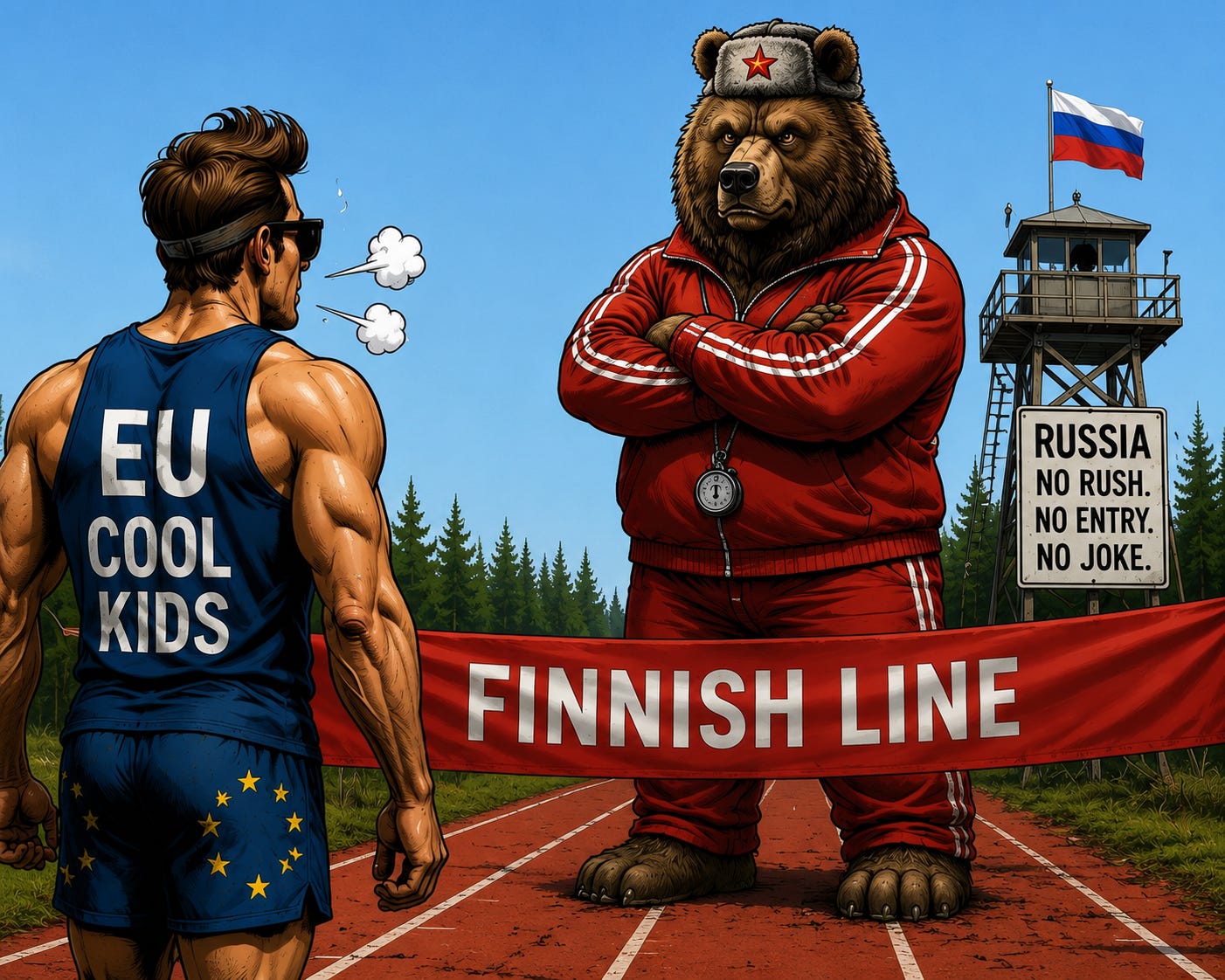
EU Cool Kids
As outlandish as it may sound, Finnish President Alexander Stubb’s successful push to get his parliament to repeal a decades old, profoundly important nuclear safeguard has nothing to do with Finland’s security and instead has everything to do with his personal obsession with being accepted by the globalist elites. Stubb, like many within the EU establishment, wants to be invited to the right events, be seated at the best table, and be liked by a certain class of society. He aspires to project power with the Davos crowd, and to eventually make colossal amounts of money for simply being an EU cool kid himself. To facilitate these shallow ambitions, Stubb was willing to push through outrageously reckless legislation to repeal Finland’s ban on nuclear weapons. As such, this is far worse than just a bad deal for the Finns.
It must also be pointed out that Alexander Stubb is doing all this with a full understanding of the potential consequences. This is because Stubb is anything but politically naive or inexperienced. He comes from a wealthy, powerful Finnish family. His father was NHL Director of European Scouting and he is also the great-grandnephew of Eemil Nestor Setälä. Setälä served as acting head of state, chairman of the Senate of Finland and was the principal author of Finland’s Declaration of Independence. He also served as Foreign Minister and Minister of Education.
Given this background and his upbringing, Alexander Stubb is all too aware that his campaign to repeal the ban on nuclear weapons is terrible for Finland and may potentially lead to a nuclear war. Unfortunately, his priority is to be invited to sit at the EU Cool Kid table and he will proudly facilitate NATO requests even if they are detrimental to the people and nation that he serves. Simply put, Stubb is more than willing to sacrifice Finland to satisfy his personal need to impress the globalist elite.
Conclusion
Setting aside President Alexander Stubb’s personal ambitions, there is no viable or justifiable reason that Finland should have voted to repeal its ban on nuclear weapons on its territory. Finland already possessed the maximum deterrence available through NATO and the United States nuclear umbrella, the strategic flexibility to maintain relations and trade with both East and West, and a competent military of its own. Beyond that, Finland has more than two centuries of experience managing a productive relationship with Russia, dating back to 1809.
At every stage of that relationship, whether under Tsar Alexander I, Vladimir Lenin, or during the post Soviet era of the Russian Federation, Finnish and Russian relations remained remarkably stable despite outside tensions between Russia and the collective West. Most notably, Russia repeatedly demonstrated a willingness to allow Finland to preserve its independence and autonomy, even during periods of profound geopolitical change and conflict.
Given such a unique relationship, it is difficult to understand why Finland would choose to throw all of this away with nothing tangible to gain in return other than a potential seat at the EU cool kids table for President Alexander Stubb.
As I have written about previously, and as can be seen time and time again, the collective West, and particularly EU leadership, are pursuing policies that are highly irrational and contrary to their own long term interests. Given the increasingly irrational nature of these decisions and actions, the one consistent theme is a hankering for an all out war between NATO and Russia. I sincerely hope that day never arrives. Yet, from my perspective, the trajectory of current policy suggests that, for the EU cool kids, this is the ultimate FINNISH LINE.
As always, I thank you for your continued support and readership.
Until next time,
Jon Kurpis
DISCLAIMER: This article is published strictly in my personal capacity and reflects only my individual views and analysis. Nothing herein should be interpreted as an official statement, communication, or policy position associated with my role as an elected official, any municipality, governmental authority, political party, or affiliated public institution. Furthermore, the perspectives expressed do not necessarily reflect the views or positions of The Duran.
Thanks for Reading!
Feel Free to Share, Comment and Subscribe!
Finland is experiencing economic downturn, helped by the cutoff of Russia which was a substantial part of their economic activity.
They joined NATO and now have a very long border to protect and real changes of a conflict to which they are not prepared. Nor is NATO.
Europe says it is preparing f a conflict w Russia in 3-5 years. They assume they will have produced enough weaponary ( which they are currently losing in Ukraine) by then while at the same time assuming Russia will simply stand still.
You don't announce your intentions way ahead and expect the opponent not to react!!
As usual the one that will suffer from the Finnish government decision will be the people, no one even asked their opinion. While the so called elites and stubbystupid hide in his bunker people's life will become a hell