

Germany’s Broken Bargain

The AfD’s rise is exposing the political consequences of an economic model built on cheap Russian energy, industrial strength and a centrist consensus that is becoming increasingly difficult to sustain.
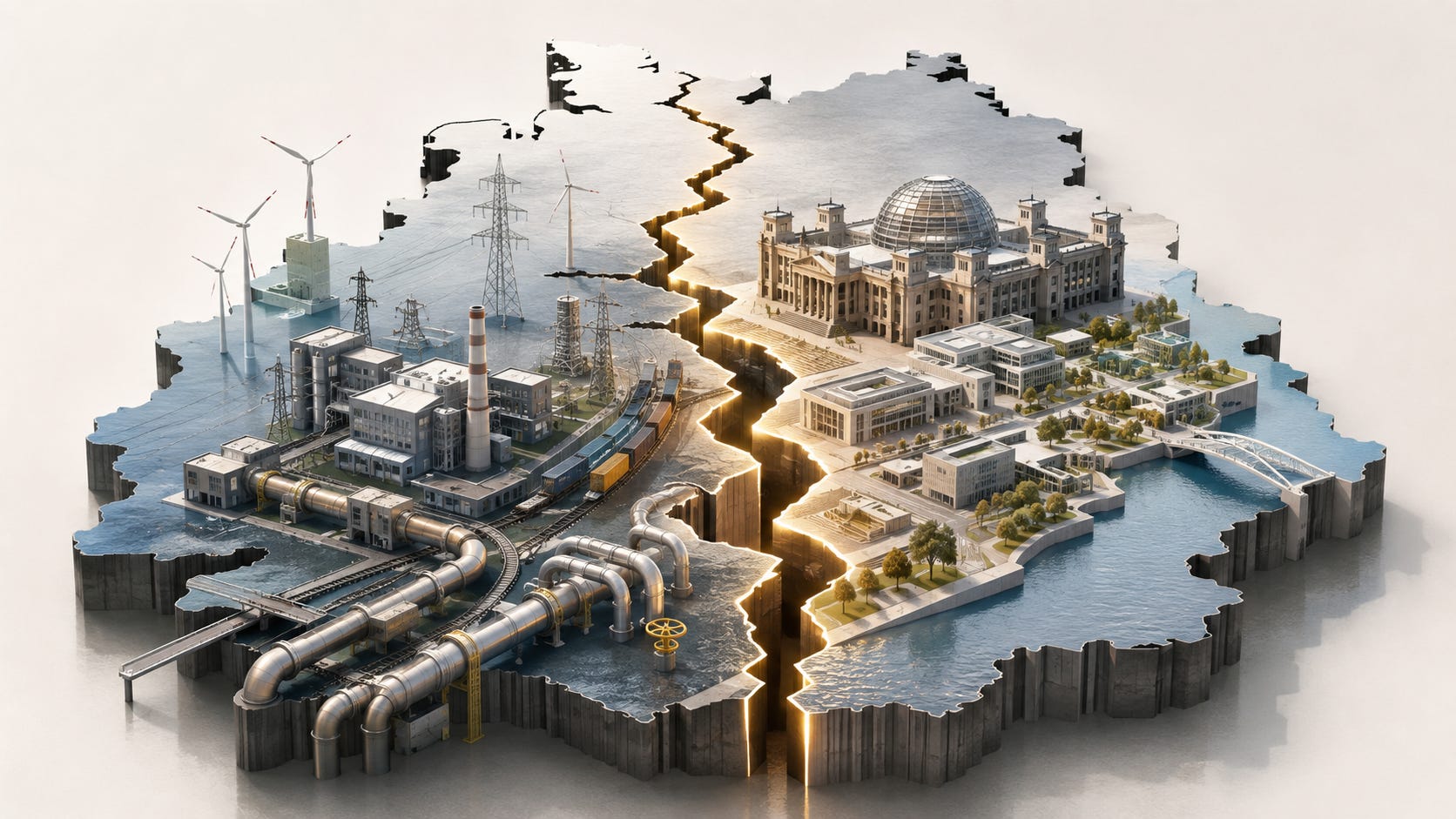
For much of the post-Cold War period, Germany enjoyed an unusually favorable strategic settlement. Russian energy supported an industrial economy built around globally competitive manufacturing. European integration enlarged the market. American security guarantees limited the cost of geopolitical protection. And a remarkably stable political center managed the distribution of the resulting prosperity.
That settlement is now under pressure from every direction.
The significance of the Alternative for Germany’s rise therefore goes beyond the fortunes of a single opposition party. The AfD is becoming the political vehicle through which a growing part of the electorate is challenging assumptions that Germany’s governing class has treated as settled: the break with Russian energy, the management of the Ukraine war, the economic consequences of sanctions and the boundaries of acceptable political debate.
What is changing in Germany is not simply the electoral map. It is the relationship between economic performance and political legitimacy.
The Economics Beneath the Politics
Alice Weidel’s attack on Germany’s abandonment of cheap Russian energy goes directly to the weakness of the existing political consensus.
Her argument is politically potent because it connects foreign policy to household and industrial economics. Germany’s energy relationship with Russia was never merely commercial. It formed part of the cost structure underpinning German industry. Once that relationship disappeared, Berlin was forced to replace a geographically convenient source of energy with a more complicated and potentially more expensive system.
The draft describes exceptionally low gas reserves, inadequate preparations for winter, pressure in oil markets and LNG supplies that have not reached the levels anticipated by Germany’s political leadership. At the same time, Chancellor Friedrich Merz is struggling to generate the political momentum expected of his government, while unpopular tax measures add another source of dissatisfaction.
This is where the AfD’s rise becomes strategically important.
Parties outside the governing consensus often advance when voters conclude that the costs they are bearing are not temporary disruptions but consequences of policies the political system refuses to reconsider. The AfD does not need to persuade every German voter of its entire program. It needs to persuade enough of them that the existing parties are defending a settlement that no longer delivers.
When Containment Stops Working
The approaching elections in Saxony-Anhalt and Mecklenburg-Vorpommern could therefore become more important than ordinary regional contests.
The AfD is positioned to lead in both, while polling in Saxony-Anhalt has raised the possibility of an outright majority. Such an outcome would give the party its first state government and potentially representation in the Bundesrat, carrying an insurgent political force directly into Germany’s federal institutional structure.
The establishment’s problem is becoming increasingly difficult to conceal. The traditional strategy has been containment: isolate the AfD politically, subject it to intense institutional scrutiny and prevent other parties from treating it as a normal coalition partner.
But containment depends on electoral arithmetic.
If the AfD becomes the largest party repeatedly—and especially if it approaches a governing majority—the cordon sanitaire begins producing increasingly awkward outcomes. Larger coalitions of ideologically incompatible parties may be required simply to prevent the strongest party from governing.
At that point, the mechanism designed to protect the political center can begin weakening its legitimacy.
The reported Green campaign effort in Saxony-Anhalt illustrates the shift. The objective is no longer necessarily preventing an AfD victory, but preventing an AfD majority. That is a much more defensive political position.
Join The Duran Community
Subscribe and Support The Duran!
Germany Cannot Isolate Itself From Strategy
The economic crisis is also arriving as Germany’s external environment becomes more demanding.
The Ukraine conflict continues to consume European political and military attention while Russian forces increase pressure across western Donbas and Zaporizhzhia. At the same time, American military resources described in today’s draft are increasingly concentrated toward the Middle East, including carrier deployments that could leave no US carrier strike group in Asia.
These developments are geographically separate but strategically connected.
They point toward a world in which military resources, energy supplies and industrial capacity are once again scarce assets that governments must allocate among competing priorities.
For Germany, this is particularly uncomfortable. The country constructed its political economy during a period when economic integration and strategic security largely reinforced one another. Today they can pull in opposite directions.
Supporting geopolitical confrontation can impose industrial costs. Rearmament requires fiscal resources. Energy diversification requires infrastructure and capital. Maintaining social cohesion becomes harder when growth weakens.
Foreign policy therefore returns home as domestic politics.
The End of the Automatic Center
This is why attempts to understand the AfD exclusively through the language of extremism risk missing the larger political transformation.
Germany may ultimately restrict the party, contain it, defeat it electorally or force it to confront the difficulties of governing. The draft itself raises the possibility of allowing an AfD administration to take office before subjecting it to intense institutional and political pressure.
But none of those approaches resolves the conditions producing its support.
The deeper problem is that Germany’s traditional parties increasingly have to defend policies whose economic consequences voters can experience directly. If industrial weakness, energy insecurity and fiscal pressure persist, arguments once confined to the political margins can become increasingly difficult to exclude from mainstream debate.
Even the renewed discussion surrounding Angela Merkel is revealing. Whatever comes of it, looking backward for political authority is usually a sign that the present has failed to produce an obvious successor.
Germany’s political system was exceptionally stable when its economic model generated sufficient prosperity to absorb strategic compromises.
The coming test is whether that stability can survive when those compromises begin carrying visible costs.
The AfD may be the immediate beneficiary. But the real protagonist is something larger: the erosion of the material foundations that sustained Germany’s political center.
And that is why what happens in Saxony-Anhalt will not stay in Saxony-Anhalt.
Please share with your friends, leave a comment, and subscribe!
Thank You for Supporting The Duran!
The AfD's rise began as a professor's party founded in opposition to the abolition of the deutschmark and its replacement with the euro. But the roots of malaise go back even further when Helmut Kohl completely botched the unification with the east. His one west mark for one east mark was a total disaster. In fact the former DDR has never recovered. Germany has been in the grips of predatory capitalists ever since then. Another price Germans had to pay was a lobotimized political discourse which allowed successive governments to turn a blind eye to Israeli crimes, US imperialism and so on. Let us not forget that de-nazication was also a very bizarre affair and many of the children or grandchildren of the WWII generation seems to think they could succeed against Russia where Napoleon. and Hitler couldn't. In all they like the predatory capitalist Europe they represent is doomed.
Out of the frying pan, into the fire.