


Jon Kurpis is an elected official, writer, and entrepreneur dedicated to advocating for everyday citizens. Known for his independent mindset and principled approach, Kurpis is respected for holding those in power accountable. His background in government, policy, and geopolitics makes him a trusted voice on complex political and cultural matters. He is a Contributing Analyst for The Duran Daily. More of his work can be found on his Substack, kurpis.substack.com.
Before I begin this article, I want to make it abundantly clear that nothing that I am saying is inherently pro-Trump, anti-Trump, pro-America, or anti-America.
While I’m aware that both the United States, especially in terms of foreign policy, and the current president, as well as other presidents, are controversial, judging these actions through a partisan lens is not what this piece is about. While I, like every human, has personal opinions, my writing does not engage in binary political theatrics. I therefore want to caution everyone from the outset that if you are the type of reader who will reflexively get upset at U.S. foreign policy mistakes and especially those that have to do with Donald Trump or Joe Biden, then this article may not be for you.
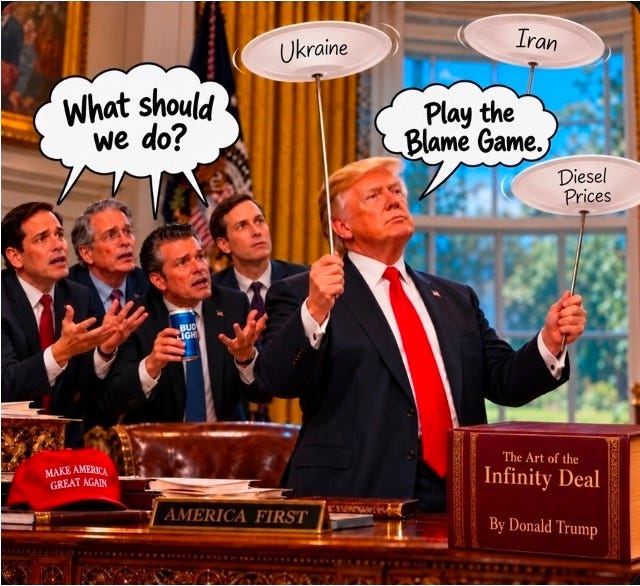
What this article intends to provide is an understanding of how the presidential blame game works. This will be accomplished from the perspective of how the wars in Ukraine and Iran have transpired, including their role in the record cost of diesel and how President Trump and his administration will handle the fallout.
So with that said, let’s get into the details.
Ukraine
Although the war in Ukraine has its roots going back as far as 2014 and even before, it became a major U.S. foreign policy objective in 2022 under the Biden administration. President Biden made supporting Ukraine a central part of his term in office, and, as a result, Biden bears much of the responsibility for the conflict, especially in regards to it’s continuation and escalation.
That said, Biden isn’t in the Whitehouse any longer and Donald Trump is the sitting President of the United States. When Trump was campaigning for a second term in office, he routinely promised that US would disengage from Ukraine if elected, even going so far as to say he could end the war in 24 hours. Yet, once he assumed the presidency in early 2025, Trump did not follow through on that promise.
Not only did President Trump fail to disengage, he continued providing critical targeting data, selling weapons, and even questioning Zelensky about his failure to attack Russia directly. And by approving new sanctions against Russia, Trump essentially assumed Biden’s policies thereby making the conflict in Ukraine his war, rather than something he solely inherited from the previous administration.
While the vast majority of rational, geopolitically astute people will interpret it this way, America does not always operate rationally, as you’ll come to see.
Iran
In stark contrast to the conflict in Ukraine, which did have its start under a prior administration, the current war with Iran falls squarely on the shoulders of President Trump.
· It was President Trump who allowed Israel to strike Iran during ongoing technical negotiations in June 2025.
· It was Donald Trump who failed to heed the warnings about attacking Iran from his own handpicked intelligence advisors, such as Tulsi Gabbard and Joe Kent as well as his Vice President J.D. Vance.
· It was Trump’s State Department and his Secretary of State Marco Rubio who were essentially non-existent during negotiations with Iran in February 2026.
· And it was President Trump who was tricked by Israeli PM Benjamin Netanyahu into backing the catastrophic decapitation strike on Iran that killed their supreme leader and others on February 28th, 2026, and is directly responsible for the conflict that still remains unresolved to this day.
As a result, there is nobody to blame for the diplomatic confusion, economic repercussions, issues with the Strait of Hormuz, and regional instability that persists, other than President Trump himself.
Now one would think that it would be clear to anyone evaluating the current situation that the war in Iran and the continuation of the conflict in Ukraine are Trump’s responsibility and therefore his fault. After all, President Trump is the leader of the free world and these are his decisions to make. But from a US societal standpoint, it isn’t cut-and-dry and this gives Trump an opening to aggressively play the blame game to muddy the waters.
The Blame Game
When it comes to how the presidential blame game works in America, there is one thing that usually dictates responsibility above everything else.
He who introduces the person or source of the problem commonly gets stuck with the blame.
This is the broader pattern: although often unfair, American society sometimes accepts blame being pushed away from the people who deserve it and onto people who, while technically playing a role, may not be the ones who should bear full responsibility. That distinction between direct culpability and responsibility for creating or enabling a relationship is essential to understanding how the blame game works in practice.
Nobody understands the intricacies of the blame game better than Donald Trump. In fact, Trump’s capacity to confidently place blame is arguably a reason for his success. Love him or hate him, few people bounce back from failure better than Trump, as seen in the way he has jumped from one business failure to another venture without missing a beat.
Case in point, Trump’s New Jersey Generals USFL football team failed. Then Trump Shuttle went up in smoke. Next, the Trump Taj Mahal went under, followed by Trump Plaza Casino and issues with the Plaza Hotel in NYC. After that, he lost Trump Hotels & Casino Resorts. Even his reality TV catchphrase, “You’re Fired!”, is fundamentally about blaming someone else for a team failure.
Ultimately, Donald Trump has made a fortune despite his failures because he has been able to reinvent himself, which has involved blaming others.
Beyond Trump himself, the President’s inner circle are by and large wealthy egomaniacs who will not accept responsibility or blame in accordance with what’s right. While I’m not saying every person in Trump’s administration plays this blame game. I am saying the list of people who operate this way includes Donald Trump, Scott Bessent, Marco Rubio, Howard Lutnick, Jared Kushner, and Pete Hegseth. And with the exception of Obama and Biden’s inner circles, there probably has never been a group less likely to take blame than the people mentioned above.
This reality and operational mindset should be understood and applied if one wants to accurately forecast how issues will likely play out during the remainder of Trump’s presidency.
Join The Duran Community.
Subscribe and Support The Duran!
The Current State of Affairs
Given the way the blame game typically operates, it may not actually matter that President Trump has enabled Ukraine to keep fighting the war with Russia. The masses will be quick to accept that the blame for the US role in the Ukraine war falls on Joe Biden as he got America into the mess rather than with President Trump who mishandled it.
Along similar lines, if Alexandria Ocasio-Cortez (AOC) were to somehow win the Presidency in 2028 and proceed to nuke Tehran, Donald Trump will still get the blame for Iran just like Biden will with Ukraine.
The key point is that blame can always be placed on the originator of the issue by subsequent leaders. While this is in some instances intellectually dishonest, it is, unfortunately, how things most frequently end up.
And this is how Trump will play the game for the remainder of his presidency.
In terms of where everything stands today, the wars in Ukraine and Iran are unresolved disasters, and the US diesel fuel shortage is the straw that broke the camel’s back.
The reason why this is imperative to discuss now is because U.S. Treasury Secretary Scott Bessent said something recently that setoff geopolitical sirens.
On September 2nd, 2026, Treasury Secretary Bessent quietly assigned responsibility for the global “energy shock“ to the Russia-Ukraine war when he stated, “Ukraine has decided that they want to blow up Russian energy assets and refined products.”
And in his opinion, this was the cause of “upward price pressure on a global basis.“
Make no mistake about it, President Donald Trump and his administration, vis-à-vis Scott Bessent, laid the foundation of blame for rising energy prices on Ukraine and their attacks on Russian refineries and infrastructure and it was deliberate.
Then, on September 13th, President Trump publicly let it be known that he spoke with Ukrainian President Volodymyr Zelensky about the matter and ordered him to stop. Trump said, “Mr. Zelensky has to do one thing. He has to stop knocking out diesel fuel in Russia... because he’s causing a shortage of diesel.”
The following day, on September 14th, Trump followed this up and concretely established that the diesel shortage wasn’t being caused by the conflict in Iran, but instead by Ukraine’s attacks on Russia.
Trump wrote, “The world’s diesel price rise is mostly caused by the Russia-Ukraine war, not Iran.”
I have long assumed that President Trump would opt to use the blame-game strategy in one form or another after the midterm elections. But the surge in diesel prices, combined with the ongoing fighting in the Middle East and Russian military gains in Ukraine, has made it something that must now be deployed in the lead-up to the November 3rd midterm elections.
Below, we will investigate why the world diesel shortage is so impactful as well as take a deeper look into President Trump’s certain use of the blame game going forward.
Why Diesel Matters
Unlike gasoline, which is used primarily for automobiles and other consumer machinery, diesel fuel backbones the overall economy. Trucking, agriculture, freight locomotives, construction equipment and machinery, ships, tugboats, ports, mining equipment, oil and gas drilling, school buses, ambulances, fire trucks, and more all rely on diesel to operate.
Fortunately for America, US diesel production essentially accounts for 100% of their domestic needs with leftover inventory available to export. In 2025, the US produced 76.5 billion gallons of diesel and used 59.9 billion gallons internally. Interestingly, the US exported 19.2 billion gallons which is more than the amount leftover, but is possible through cheap imports that are then resold for a profit.
While rising gas prices hit consumers immediately, the more devastating economic issue is when diesel costs increase, as it hits businesses and supply chains that then pass the cost on to consumers. So, while the average Joe may not be feeling it initially at the pump, the financial impact on that individual is far worse when the price of diesel climbs.
Because of the numerous ways diesel is utilized throughout the economy, a pressing issue for President Trump is that he will now be hearing complaints from people who matter to him, aka the wealthy donor class and corporate executives. As a result, the skyrocketing diesel prices that America is experiencing are wholly unacceptable, and Trump didn’t see this massive problem coming.
More importantly, President Trump is also now aware that if this diesel issue continues, there is no way to stop it from trickling down to consumers in a serious way.
Although I have no direct proof of it, I believe that the cost of diesel and it’s down the line repercussions are a partial reason why the Trump administration has floated the idea of a $5000 “Trump Dividend” if Republicans retain both the House and the Senate after the November elections.
“If the Republicans win, you win with us and you get $5,000.” ~ President Trump
I suspect that if the Republicans win, Trump will make good on that promise because it will subtly offset the short-term impact on the consumer caused by higher diesel prices. And if the Republicans lose either the House or the Senate, Trump has provided himself with a mechanism to blame the Democrats for not giving Americans $5,000 when they will be hurting from rising costs.
While these sorts of campaign bribes are not altogether uncommon on both sides of the aisle, they rarely materialize for the people. That said, I view this particular instance as unique as it is likely connected to the diesel situation.
Either way, the reality of soaring diesel prices has forced Trump’s hand and he will now be in full blame game mode for the remainder of his presidency.
Russia-Ukraine
From a personality standpoint, it is obvious that Donald Trump views the War in Ukraine very differently from the conflict in Iran. Whereas Trump has a long history of disliking Iran, he doesn’t genuinely appear to be interested in pursuing a conflict with Russia. If anything, Trump views the fighting in Ukraine as an unnecessary barrier that is preventing the United States from partnering on lucrative ventures with the Russians. Moreover, Donald Trump admires Putin, despises Zelensky, and doesn’t give a damn about the EU.
That said, President Trump is truly his own worst enemy. He is reckless in terms of managing risk, generally impulsive, prone to siding with neocons, and incapable of doing anything that can even be loosely construed as taking a loss.
And the hard truth of Trump’s second term is that he has been too weak a president and too prone to fall for neocon arguments to meaningfully disengage from the conflict in Ukraine. Instead, Trump has opted to sell NATO and Europe weapons to pass on to Ukraine while also wasting time pursuing half-hearted diplomatic negotiations headed by amateurs such as Jared Kushner. Unbelievably, Trump then justifies his failure to disengage by criticizing Biden for simply giving weapons to Zelensky whereas he was the shrewd one because he sold weapons to them via a third party instead.
It’s difficult to even capture the ridiculousness of Trump’s excuse. The fact of the matter is that Trump promised voters that he would disengage from a terrible war in Ukraine. Yet instead of ending the conflict and putting a stop to the death and destruction, he has enabled the fighting to continue just as Biden did. But this time, the justification is that the way he’s doing it is somehow better because it makes the military-industrial complex a lot of money.
Now for all the people out there who love to claim that President Trump is playing 10-D chess, in this instance, he is at best playing negative eight-bit checkers and in all honesty getting crushed in the process.
Middle East
In terms of President Trump’s Iranian miscalculation, his administration has made many mistakes. First, neither the President nor his pro-war advisors took into account that Iran is a viable military force. They also failed to calculate the military capacity and inventories needed to defeat Iran while simultaneously defending our allies in the region. And this also indicates that President Trump did not understand America’s inability to surge military production.
It should be therefore no surprise that when the U.S. military inventory that Biden depleted to supply Ukraine combined with further depletions from the Trump administration and US allies selling weapons to NATO to pass on to Zelensky, President Trump found himself ill-equipped to pursue the war with Tehran, and Iran subsequently exposed these vulnerabilities on the battlefield.
Beyond military capacity complications, the war with Iran has also led to restrictions on shipping through the Strait of Hormuz.
While Trump may not have anticipated how the situation with the Strait of Hormuz would unfold, it is reasonable to assume that he was aware that a strike on Iran could interfere with gas and oil coming out of the Middle East and cause prices to rise. That said, President Trump was cocky and didn’t prepare for the worst-case scenario. This is because Trump was working under the flawed assumption that he could end the war quickly if he needed to mitigate the financial fallout.
Furthermore, Trump’s attention was fixated on gasoline prices and seemingly neglected the possible ramifications for diesel. His strategy focused on the notion that if gas prices increased due to the conflict, he could offset them by depleting U.S. strategic petroleum reserves. While that technically can help with diesel production, the premium required to refine diesel keeps the price higher than gasoline. That said, when gas prices surged after the conflict started, that was exactly the move the Trump administration made to keep consumer costs under control.
What President Trump seemingly didn’t account for was overseas demand for diesel becoming so intense that it would raise U.S. domestic prices. As a result, diesel skyrocketed from approximately $3.80 per gallon before the conflict to the current record price of around $6.50 per gallon. That’s an increase of $2.70 per gallon, or approximately 70%, since late February 2026, when the U.S. and Israel launched the unprovoked war against Iran.
Putting Everything in Its Proper Place
From where things stand today, the most important aspect to understand is that diesel prices have hit the point of no return, and Donald Trump must now blame the increase on someone or something other than himself.
The truth is the surge in the price of diesel mostly stems from Middle East supply shortages which are in turn the direct result of the US war with Iran. Moreover, this conflict is ongoing and President Trump has no realistic path to end it, at least not in the short term.
The only thing Donald Trump can do is shift the blame for diesel shortages away from the middle east debacle that he caused and instead blame Ukraine which he can then pin on the prior administration. This is already being done by pushing the narrative that Ukrainian attacks on Russian energy infrastructure are to blame for the diesel price increases.
Although Ukrainian strikes into Russia have reduced the amount of diesel on the global market, they are not genuinely responsible for rising U.S. domestic diesel prices as Russia isn’t a major exporter to Europe, which is the region of the world that is desperate for the fuel and driving up the prices.
At the heart of the problem is the fact that Europe won’t purchase cheap Russian diesel as they did before the start of the war in Ukraine. Instead, Europe now relies on the Middle East and the US for it’s supply. According to recent figures, the Middle East produces roughly 40% of Europe’s diesel imports while the U.S. now accounts for 50%. But as a result of the war in Iran, however, Middle Eastern infrastructure has been damaged, and energy flow through the Strait of Hormuz has slowed considerably. Without cheap Russian energy as an option and with limited Middle Eastern output, Europe has placed immense demand on U.S. diesel inventories. That, in turn, has driven up domestic diesel prices in the United States. And since Trump doesn’t have the diplomatic skills to immediately end the hostilities in the Middle East, supply pressure will continue to inflate the diesel market, at least in the near term.
The bottom line is the economic fallout from record diesel prices will be passed on to American consumers. President Trump understands this and now needs to cover his own backside. And as a result, he will fall back to what he excels at which is using rhetoric and his platform to blame this failure on something or someone other than himself.
Enter Ukraine…
Given that President Trump campaigned on disengaging from the War in Ukraine, it should have been easy to dump the entire conflict on the Biden administration. However, Trump was foolish enough to enable the fighting in Ukraine to continue, just as had been done by the prior administration, so he also now finds himself needing to cover his backside for that debacle as well. This is why it is imperative for Trump to make Joe Biden the very public fall guy for Ukraine. And while this narrative isn’t entirely without merit, it certainly isn’t the full story. Truthful or not, Trump must shield himself to protect his political legacy and therefore diesel prices will be connected to Ukraine and Ukraine must be tied to Biden.
But what about Iran?
Although it’s both disheartening and infuriating that elected officials spend considerable time on nonsense such as the blame game, it is an aspect of American politics that must be accounted for. And in-line with that reality, it is fairly straightforward in terms of how Donald Trump will play the blame game at least insofar as connecting high diesel prices to Ukraine and then blaming Ukraine on Biden. What is not nearly as well understood is how Trump intends on using the blame game strategy with Iran when he is the original source of the problem.
As we discussed earlier in this piece, the politician or person who introduces the problem usually takes most of the blame. That means there is no way for President Trump to fully remove himself from responsibility for his role with the war with Iran. However, Trump can, and more importantly, will intentionally make the waters murky through the use of a multi-front rhetorical assault focused on at least five different elements that I’ve identified and will discuss below.
First and foremost, there’s the issue of nuclear weapons, which is one of those matters that Americans always fall for. The facts show that Iran did not pose a nuclear threat to the US. Even so, Americans believe that the risk of Iran attacking the United States or Israel with a nuclear weapon was real. Because of that, President Trump can justify an otherwise unjustifiable attack on Iran by claiming, as he often does, that he couldn’t sit by and let Iran get a nuclear weapon. This nuclear connection will definitely provide Trump with some slack despite the fact it hinges on the idea that he tried to rectify a fake problem by attacking Iran.
The second way President Trump will deflect responsibility for the catastrophic war with Iran is by blaming the military failures on Biden for depleting a critical amount of U.S. weaponry and resources on Ukraine. Truth be told, that’s partially correct. But if President Trump hadn’t carried out an unprovoked strike on Iran, the U.S. wouldn’t be in this mess. So ultimately, blaming Biden will only go so far in terms of helping deflect accountability away from Trump in relation to Iran.
The third thing President Trump will blame the outcome in Iran on is how U.S. allies didn’t join the fight. Whether it be NATO countries, South Korea, or someone else, Trump will angle the blame game against our allies, and there is a possibility it will resonate with some Americans.
A fourth way President Trump may use the blame game is to push the narrative that America is better off with the current Iranian leadership than it was with the prior one. This is in truth an absurd claim without any merit behind it, but Americans will not understand the dynamics and almost certainly believe it.
The fifth way Donald Trump will attempt to shift the blame for Iran is by claiming that China was helping Iran in the war. While China and Russia have played a role, Russia has done the most to assist Iran. That said, because the U.S. initiated hostilities with Russia by funding a proxy war against them in Ukraine, it isn’t viable to condemn Moscow for essentially doing the same thing to the United States via Iran. Furthermore, blaming Russia doesn’t fit into the storyline, whereas China is America’s next big enemy and fits perfectly with the American empire neocon narrative. As such, Trump will attempt to include China in his Iran war blame game.
At the end of the day, no amount of clever deflection will completely shield Donald Trump from his role in the war with Iran. Trump will always bear some blame for the conflict, but his responsibility may be significantly dampened after he blames the conflict on the issue of a nuclear-armed Iran, weapon shortages connected to Biden and Ukraine, a lack of support from allies, a false narrative that the new Iranian leadership is better for the United States than the prior Supreme Leader, and the excuse that China assisted Iran against our interests.
This is how, in my opinion, President Trump will deploy the blame game to minimize his role in the disastrous war with Iran when all is said and done.
Conclusion
Regardless of what President Trump has or hasn’t done thus far in his second term, the likelihood of any president holding on to both the House and the Senate in a midterm election is a tall order. Win or lose, Trump must deal with multiple conflicts with difficult connected issues to account for. And to be clear, his remaining time in office and his legacy will be determined by how he resolves them. For all his obvious shortcomings, Trump is objectively a master of rhetoric and of blaming others. And because that is his core strength, Trump will connect high diesel prices and the Ukraine war and then dump it all on Joe Biden. That said, the more difficult task will be shielding himself from the fallout of an unprovoked war with Iran that he launched and that cannot be so easily blamed away.
When it comes to geopolitical issues of such complexity, there is no shortage of opinions as to how things will play out. And as much as we may wish we had a crystal ball, there is no guaranteed mechanism to predict what will occur in every aspect of these extremely difficult situations. That said, the one thing that is a guarantee is that President Trump will deflect responsibility for high diesel prices, the war in Ukraine and the conflict in Iran from now until his last day in office and beyond. And the reason we can be sure of that inevitability is because I, and now you as well, know “How The Presidential Blame Game Works.”As always, I thank you for your continued support and readership.
Until next time,
Jon Kurpis
DISCLAIMER: This article is published strictly in my personal capacity and reflects only my individual views and analysis. Nothing herein should be interpreted as an official statement, communication, or policy position associated with my role as an elected official, any municipality, governmental authority, political party, or affiliated public institution. Furthermore, the perspectives expressed do not necessarily reflect the views or positions of The Duran.
Thanks for Reading!
Feel Free to Share, Comment and Subscribe!
Thank you Sir, for writing in the manner that a regular citizen can understand your thoughts. This article gives me a new reasoning why and how we are in this mess and also how the dear president's mind works.
Great analysis! It will also have been the fault of domestic media spreading demoralising fake news, corporate and indy. The Empire won't miss a trick.