

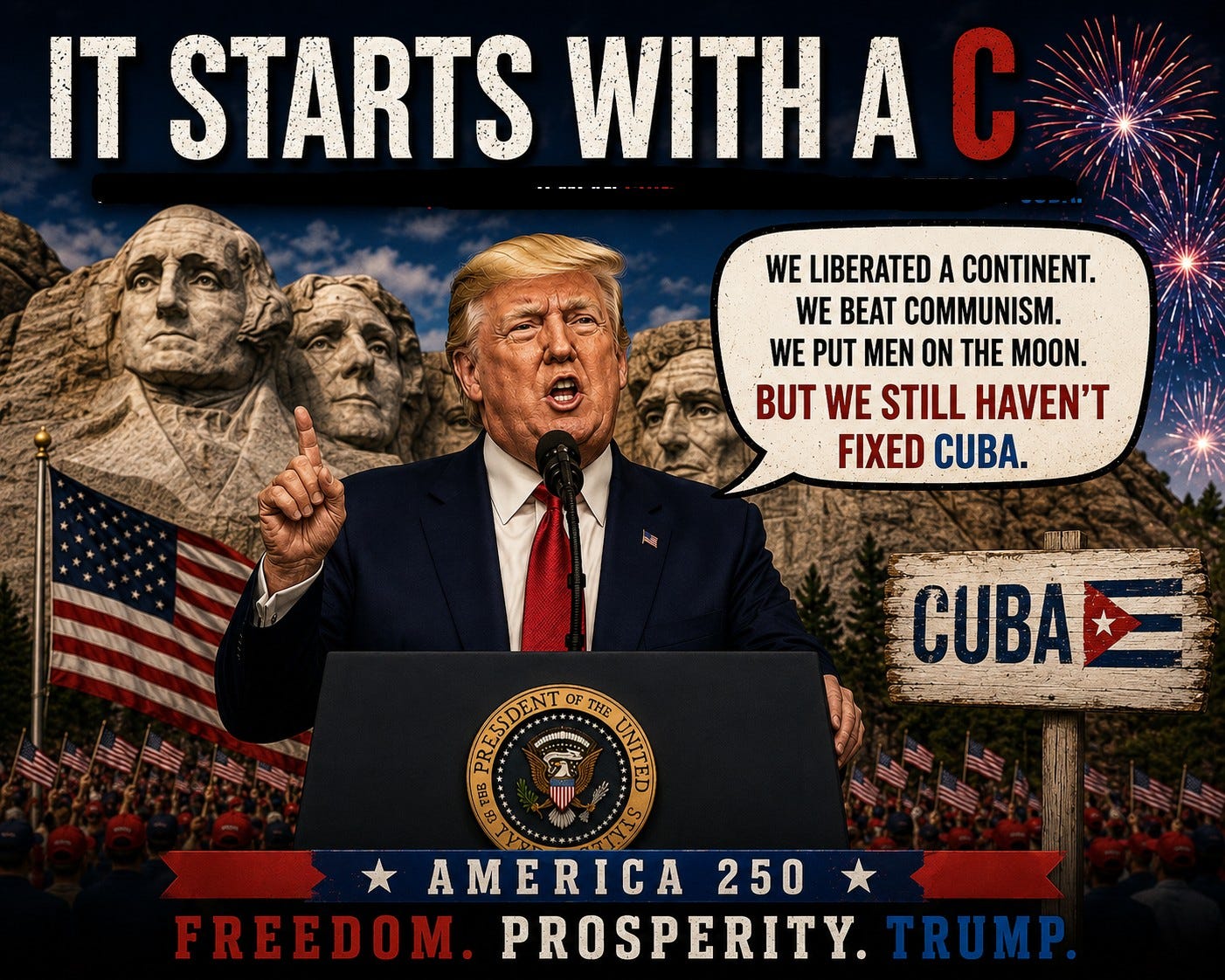
It Starts with a C
Why President Trump's July 3rd, 2026 speech warning about communism may signal a near-term attack on Cuba.

Jon Kurpis is an elected official, writer, and entrepreneur dedicated to advocating for everyday citizens. Known for his independent mindset and principled approach, Kurpis is respected for holding those in power accountable. His background in government, policy, and geopolitics makes him a trusted voice on complex political and cultural matters. He is a Contributing Analyst for The Duran Daily. More of his work can be found on his Substack, kurpis.substack.com.
On July 3rd, 2026, President Donald Trump gave a rousing pre Independence Day speech at Mount Rushmore to kick off America’s 250th birthday. As one might expect, it was delivered in a manner that only this particular President is capable of producing. The address was a jolly array of patriotic banter, over-the-top boasting, and homage to Donald Trump himself.
“There has never been anything like this. The triumph of American independence was the result of the most extraordinary people in history, the most extraordinary culture in history, and the most extraordinary ideas in history, all creating the most extraordinary republic ever, ever, ever in history. It all came together for the miracle of July 4th, 1776. That was a big year. 250 years ago tomorrow, what a big day that is. I consider this a big day because I’m with you. I like that too. And by the way, we won big here. We won really big, each, each and every time.” ~ President Donald Trump
Beyond the ego, fluff, and patriotic zeal, however, President Trump also layered in moments of seriousness. He noted how fortunate Americans are, as “…most people in most places have lived a life plagued by suffering, poverty, exploitation, violence, and misery” and that an “American always wants peace and order, but we will never shrink from danger or threat.”
The most significant part of the speech came when President Trump pivoted from patriotism to a rebuke of communism. While the transition was slightly unexpected, it was not all that surprising. As I have said time and time again, Americans despise communism! A large portion of the US population and Trump’s political base were also alive to witness the end of the Cold War and the fall of communist countries. Given that this was a speech celebrating our nation’s history, success and values, bringing up communism as a contrast was not out of place.
President Trump described communism as “a mortal threat to American liberty.” and characterized it as “the enemy of free people…everywhere in the world.” He also labeled communism as “the exact opposite of life, liberty and the pursuit of happiness” and “an ideology of mass theft, mass control, mass lies, and mass murder.”
That said, President Trump’s critique of communism went far beyond just these assertions, leaving many to wonder what the real motivation was for making it such a deliberate part of the speech. Most analysis correctly assumes that this rhetoric marks the beginning of a 2026 midterm election strategy in which the Republican Party will attempt to associate the Democrats, their policies, and their candidates with communism. Although this approach has been used in the past, and many Democrats have embraced positions that invite such criticism, that explanation may only scratch the surface of what was actually being conveyed.
Based on the specific words President Trump chose and the geopolitical and domestic circumstances currently in play, a strong case can be made that while the discussion of communism will certainly support a midterm election strategy, the deeper signal was the likelihood of an imminent war with Cuba. This article explains the logic and evidence behind this postulation.
The Rationale for Cuba
For nearly as long as the United States has existed as an independent nation, we have, in one way or another, had our sights set on Cuba. Even Founding Father Thomas Jefferson famously declared, “We ought, at the first possible opportunity, to take Cuba.” Consequently, it is unsurprising that by the early nineteenth century, the United States had emerged as Cuba’s largest trading partner.
From a military perspective, the US also viewed the prospect of a hostile power establishing itself 90 miles from Florida as an unacceptable security risk. To guard against such a scenario, the Monroe Doctrine effectively treated Cuba as off limits to foreign powers.
Seeking territorial expansion for the United States, President James K. Polk offered Spain 100 million dollars for Cuba in 1848 and President Franklin Pierce offered 120 million in 1854. In both instances, Spain declined the overture.
In 1898, the Spanish American War erupted following the detonation of the USS Maine in Havana Harbor. United States forces landed on the island, occupied it for 5 years and ultimately defeated Spain. Although free from Spanish rule, Cuba soon found itself functioning as a de facto US client state. This gave America regional naval dominance while also expanding US control over Cuban railroads, sugar plantations, utilities, and other major industries. By the mid twentieth century, approximately 70% of Cuban exports were destined for the American market.
In 1959, the Cuban Revolution transformed the island nation into a communist state and it became a forward outpost for the Soviet Union. This essentially ended Cuba’s financial relationship with the United States and nearly ended the world during the Cuban Missile Crisis. Since the fall of the USSR in the early 1990s, Cuba has continued down a slow path of financial and military decline and now appears to many American neocons and neoliberal elites to be ripe for the picking.
Material Factors
In terms of scale, Cuba is one of the most extensive islands in the world. It stretches nearly 750 miles from end to end and is approximately 120 miles at its widest point. Comparatively speaking, Cuba is larger than Puerto Rico, Jamaica, Haiti, the Dominican Republic, and every island in the Bahamas combined.
Cuba is also blessed with 7 deep water ports. These ports are primarily natural rather than being reliant on dredging. They are also well protected and capable of hosting everything from container ships to oil tankers to naval vessels. In addition to the 7 deep water, they also have 11 main commercial ports, and 31 cargo ports.
Beyond its size and ports, Cuba possesses considerable untapped natural resources. The island has one of the largest global reserves of nickel and also contains iron, cobalt, copper, chromium, and manganese. These mineral deposits are valuable because many are essential to the production of aerospace alloys and batteries.
Something that is not widely appreciated is that Cuba also has sulfur rich crude oil. Although sanctions and economic pressure have prevented this valuable resource from being fully exploited, domestic production still accounts for almost 40% of the country’s fuel and energy needs.
Cuba’s physical location is also of exceptional strategic importance. In fact, it is accurate to say that whoever controls Cuba can also exert control over the sea lanes connecting the Gulf of America, the Atlantic Ocean, and the Caribbean Sea.
Moreover, Cuba’s position allows it to potentially exercise authority over several critical choke points. This includes the Straits of Florida between Cuba and the US, the Yucatan Channel between Cuba and Mexico, and the Windward Passage between Cuba and Hispaniola. These routes are of monumental significance as they are essential for US oil exports, container shipping to and from the Panama Canal, and naval movements between the Atlantic and the Caribbean. At the most fundamental level, whoever presides over Cuba controls access into and out of the Gulf of America.
Instrumental Drivers
Beyond the physical assets mentioned, there are several other instrumental drivers that are highly specific to Cuba and all of which support an American invasion of the island.
The American People
The first of these drivers is the American people and their extremely high tolerance for a war to liberate Cuba. By and large, Americans want the Cuban population free from their communist regime. The situation is particularly unique in that most anti-war America First voters would make an exception for military intervention in Cuba. As already mentioned, Americans do not like communism and there is a subtle resentment that a large, tropical island with a pro-America population is 90 miles from our shores yet inaccessible. Americans, at all levels of society, would genuinely welcome tourism, cultural exchange, and any financial opportunities that might arise because of it. Due to all this and more, Cuba embodies a military campaign that the people will largely support.
The Pentagon and CIA
The second instrumental driver is that Cuba represents the most meaningful unresolved grievance for both the CIA and the Pentagon. Both institutions remain dissatisfied with the events surrounding the catastrophic Bay of Pigs invasion. The CIA continues to view the operation as one of its greatest failures, while many at the Department of War have long argued that the United States should have committed its full military strength rather than relying on a limited covert operation. Both were further infuriated by JFK’s refusal to authorize the air strikes they believed were necessary for success.
The Bay of Pigs operation ultimately failed to establish democracy on the island and became a humiliating setback that the US endured on the world stage. Given that Raul Castro, Fidel Castro’s brother and Cuba’s Minister of Defense at the time of the invasion, is still alive, there are undoubtedly individuals within these institutions who would welcome the opportunity for a second bite at that apple even if they weren’t involved to begin with. If there is any unresolved score to settle within the institutional memory of the US military and intelligence community, it is definitely related to Cuba.
Beyond this historical grievance, however, there is also the reality of the present day. The fact of the matter is that these same institutions have once again experienced humiliation, this time in relation to Iran. Moreover, the defense and intelligence establishment are quietly unsettled by Russia’s overall performance in Ukraine and continue to be ashamed of the botched US withdrawal from Afghanistan. Given the current state of affairs, the Pentagon and the CIA have every incentive to demonstrate American military and intelligence effectiveness once again, and liberating Cuba from communism represents a relatively straightforward opportunity to restore credibility and reaffirm American dominance in the Western Hemisphere.
Longer-term Play
Besides everything mentioned above, the successful liberation of Cuba could also represent a significant long term strategic opportunity for the military industrial complex. As matters currently stand, the United States lacks the large-scale military manufacturing capacity needed to sustain prolonged high intensity conflict. Weapons, artillery, missiles, vehicles, drones, air defense systems, and ammunition production remains limited, while procurement costs continue to skyrocket.
Control of Cuba would provide the United States access to a resource rich island comparable in size to South Korea that could be developed into a major center for military production. Combined with multiple deep water ports and dirt cheap labor, Cuba is able to support weapons manufacturing on a scale that would be sufficient for America’s current and future needs. This strategic opportunity has such potential that it alone deserves consideration when assessing the likelihood of a conflict involving Cuba.
President Trump and Secretary of State Rubio
The third instrumental driver is the personal and political ambitions of President Donald Trump and Secretary of State Marco Rubio and the extraordinary opportunity Cuba holds for each of them.
For President Trump, Cuba represents what may be his final opportunity to secure a defining achievement for his legacy. Becoming the President who freed the Cuban people from communism would position Donald Trump as the American leader who succeeded where generations of others had failed.
For Secretary Rubio, the implications are equally profound. As a Cuban American who is also competing with Vice President Vance for the 2028 Republican presidential nomination, playing a key role in the liberation of Cuba could pave his path to the presidency.
For both President Donald Trump and Secretary Marco Rubio, the personal and political incentives for engaging in such a mission are immense, further reinforcing why Cuba is so likely to be part of America’s short term strategic calculus.
2026 Midterm Elections
It goes without saying that the remainder of Donald Trump’s final term in office would be unbelievably constrained if Republicans were to lose control of the House and Senate. If recent history is any indication, the incumbent party retaining control of Congress is far from guaranteed.
With that in mind, every available political advantage is likely to be utilized by the GOP ahead of this November’s midterm elections, including efforts to portray the Democrats as sympathetic to communist ideology. If political strategists in Washington believe that this sort of messaging may influence the outcome of the election, imagine how much more effective it would be if the United States were to liberate communist Cuba before voters go to the polls.
The press coverage, photo opportunities, and celebrations would be unprecedented. And it would unfold with the US government emphasizing that communism is fundamentally anti-American and destructive. It would not simply be President Trump delivering that message. The administration would elevate the voices of recently freed, native Cubans who would describe their experiences under communism with authenticity, thanking the United States and President Trump, and directly warning Americans about the dangers of communist policies.
Viewed through this prism, Republican midterm messaging focusing on communism would be meteorically strengthened by a successful invasion of Cuba. If the objective is to maximize the chances of retaining control of the House and Senate, such an outcome would provide a historically powerful narrative that would be difficult to beat.
At The Source
Before bringing this article to a close, I want to address the narrative that the Cuban people would rise up and fight American forces in the event of an invasion.
This is one of those situations where the best way to understand a population is to travel there, immerse yourself in the country, and speak directly with its people. As far as Cuba is concerned, I am among the relatively small number of Americans who have traveled throughout the country to assess conditions firsthand. I have been to Havana. I have visited the Bay of Pigs. Most importantly, I have spoken with Cubans from all walks of life across the country.
While the Cuban people are proud of their nation, my experience was that they also have a deep appreciation for the United States and the American people. Throughout my time there, I never encountered anyone who expressed anti-American sentiments. If anything, my firsthand engagement leads me to believe that, if there were ever a population that would be generally willing to welcome American forces, it would be the Cuban people.
Conclusion
After careful analysis of the US Cuba issue, it appears that a mission involving Cuba would account for virtually every reason America has gone to war in the past, as well as almost every way the United States has historically sold war to the American people. It checks the boxes of national security, regime change, power projection, oil, mineral extraction, revenge, inexpensive labor, saving an oppressed people, opening up economic opportunity, and blocking the scourge of communism.
Ultimately, a military conflict with Cuba would likely be accepted by much of the American public, the political elite, the President, the State Department, the military and intelligence establishment, and, quite possibly, many Cubans themselves. Conveniently for Donald Trump, it would also further the Republican strategy heading into the 2026 midterm elections.
Taking all of this into consideration, the words President Trump chose for his July 3rd, 2026 America 250 speech are particularly significant and hit differently than one might have initially concluded. This is especially true when looked at through the framework of a potential near-term conflict between the United States and Cuba’s communist regime.
· President Trump identified communism as a problem:
“Very simply, communism represents the worst ideas and abuses in history by the worst people.”· President Trump made it clear that communism is unacceptable:
“Such doctrines can be given no quarter…”· President Trump reminded the world that America will help a neighbor:
“always ready to help…a neighbor in need.”· President Trump lays out what the US intends to do to communists:
“send them into exile. We will send them quickly away and we will continue to build our country bigger…”· And most notably, the President of the United States swears to the world that its going to happen soon:
“So on the eve of this 250th anniversary of American heritage, we resolve and swear for all to hear that the citizens of the United States of America will vanquish communism quickly.”
When President Trump’s Mount Rushmore speech is evaluated in its entirety and considered in accordance to other factors unfolding both domestically and abroad, it’s rational to conclude that his extensive discussion and criticism of communism is potentially connected to something more than just the 2026 midterm elections.
Based on the information currently available, there is a credible case to be made that the US will attack and attempt to overthrow the communist regime in Cuba before the 2026 midterm elections. While nothing is set in stone, and I have no classified information or direct knowledge that such an operation is being planned, there is, at the very least, a more than moderate possibility that such an event will occur.
Therefore, if someone were to ask me which nation is most likely to be attacked for the first time by the Trump administration, my answer would be that it’s not China, but that It Starts with a C.
As always, I thank you for your continued support and readership.
Until next time,
Jon Kurpis
DISCLAIMER: This article is published strictly in my personal capacity and reflects only my individual views and analysis. Nothing herein should be interpreted as an official statement, communication, or policy position associated with my role as an elected official, any municipality, governmental authority, political party, or affiliated public institution. Furthermore, the perspectives expressed do not necessarily reflect the views or positions of The Duran.
Thanks for Reading!
Feel Free to Share, Comment and Subscribe!
What is this bs you are selling? That we should invade another small country that has done no harm to us, and list off the great resources we could steal from them? And that the Cuban people would welcome an American invasion of their sovereign nation
The thing you may not appreciate is that tis one thing to like American folks, yet another our system of scAmerican governance