

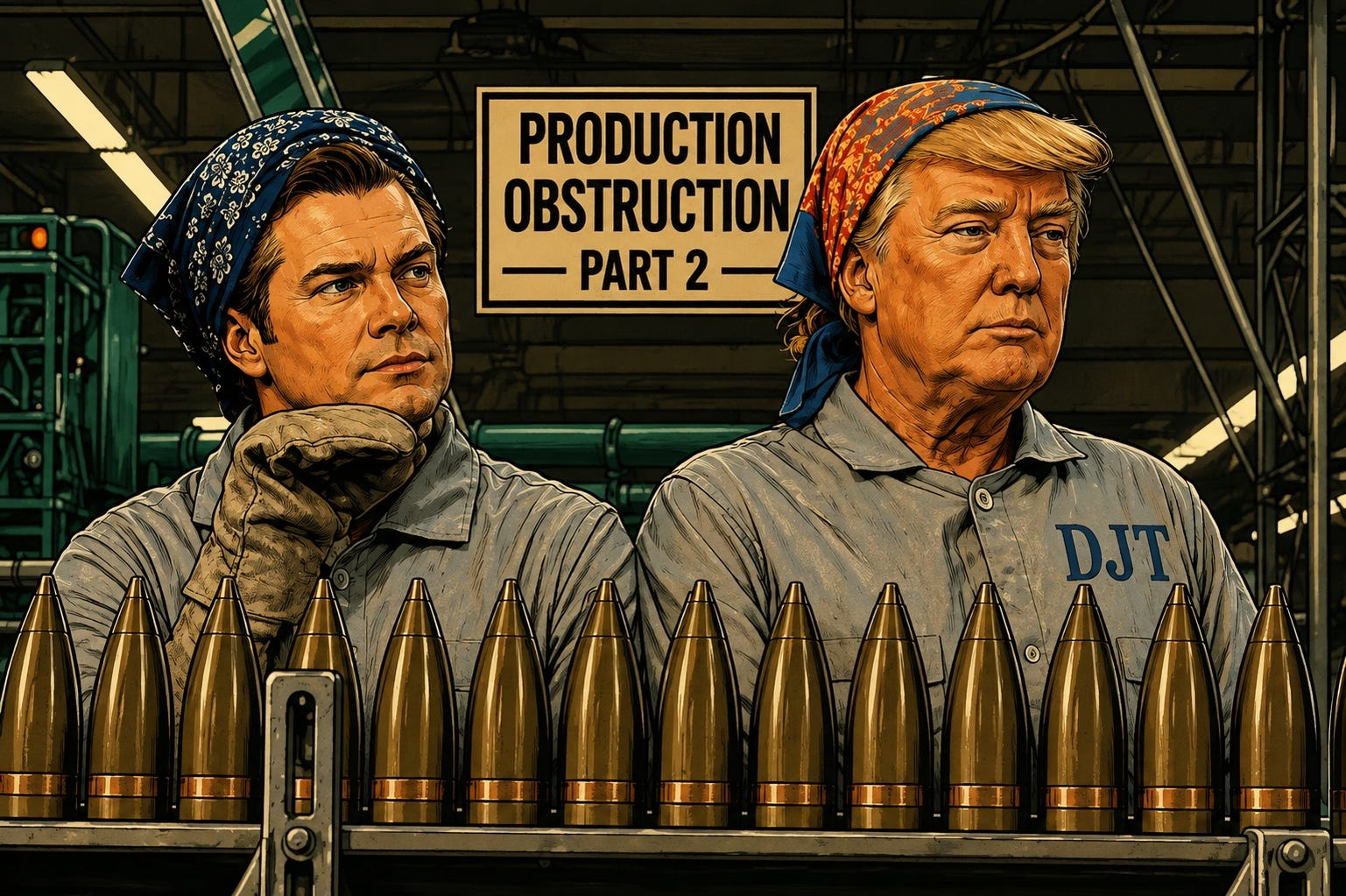
Production Obstruction - Part II
The second part and final part of a series examining the history of the American industrial war machine and the structural factors driving the United States' current military production crisis.

Jon Kurpis is an elected official, writer, and entrepreneur dedicated to advocating for everyday citizens. Known for his independent mindset and principled approach, Kurpis is respected for holding those in power accountable. His background in government, policy, and geopolitics makes him a trusted voice on complex political and cultural matters. He is a Contributing Analyst for The Duran Daily. More of his work can be found on his Substack, kurpis.substack.com.
In Part I of Production Obstruction, we chronicled America’s military production from the Civil War in the 1860s all the way through to the present day. This historical record allows us to recognize the points at which the United States made major leaps in defense production. We were also able to determine the upper limits of what is possible in terms of military output through our analysis of WWII, as well as what sustained, long-term investment was capable of achieving by the end of the Cold War. Lastly, we identified the post-Cold War strategic shift that has dramatically impeded American military production and contributed to the vulnerable position in which the United States finds itself today.
In Part II of Production Obstruction, we pick up by further examining the military production issues currently weakening the United States. Through this examination, we will identify the acute factors that have contributed to the current situation as well as determine what can and should realistically be done to address these problems.
To gain deeper insight into the general types of problems that are holding back the United States military production capacity, one need look no further than a recent Department of War Office of Inspector General report regarding the projectile metal parts facility in Mesquite, Texas. Opened in 2024 after receiving at least $469 million in defense funding, the factory was expected to deliver 30,000 critical metal projectile parts by 2026. Unbelievably, as of March 2026, the facility had failed to produce a single part.
The Department of War Office of Inspector General reported:
“Without the 30,000 additional projectile metal parts anticipated from the Mesquite facility, the Army will be unable to reach its monthly capability goal of 100,000 155 mm artillery rounds.”It further stated:
“As of March 2026, the Capability Program Executive Ammunition and Energetics officials have not developed a plan to produce the additional rounds that are supposed to be produced at the Mesquite facility.”
This example encapsulates the military production problems confronting the United States.
The Pentagon allocated nearly $500 million to construct a facility with the expectation that it would deliver 30,000 critical projectile parts by 2026. But when the time came to produce those parts, the factory delivered nothing. Adding insult to injury, the Inspector General also found that there isn’t even a plan for replacing the lost production. And as a result, critical munitions production is delayed and the Army was left without a credible backup strategy.
As an American citizen and taxpayer, I expect my country to be well prepared militarily, especially given the astronomical sums allocated to national defense every year. That does not, however, mean that I agree with America’s neoliberal foreign policy or view it as anything other than reckless and self-destructive. What I am asserting in this piece is pragmatic. If the United States is required to fight a high intensity conflict over an extended period of time, it should, in theory, have every weapon, aircraft, munition, supply, technology, and other resource necessary to defend itself for as long as required. Given America’s size, natural resources, population, and war chest, that expectation is more than reasonable. That said, it is obvious that the United States does not currently meet these standards. Despite annual defense expenditures approaching one trillion dollars, significant production bottlenecks and supply chain weaknesses remain the norm.
Three Periods of Modern US Superpower Production
To better understand why the United States has a military production problem, it is necessary to examine some key trends that have occurred since the end of World War II. These trends can be broken down into three distinct eras.
The first era spans the 1950s through the 1980s and is characterized by an immense American military industrial base with the ability to rapidly scale production to meet virtually any kinetic need. The second era covers the 1990s through the end of the 2010s and is marked by the strategic shift toward more technologically advanced forces along with considerably less emphasis placed on maintaining large stockpiles that are needed to sustain high intensity warfare over an extended period of time. The final era is the one in which we find ourselves today: the 2020s. It is defined by massive budgets that sustain continued technological investment, but also by the realization that the US needs to redevelop its military production capacity after decades of lower-volume output.
Since the end of the Cold War, the American military has prioritized becoming more technologically capable and tactically efficient. By tactically efficient, I’m referencing the ability of US forces to achieve immediate military objectives quickly and decisively. That strategic preference is the primary reason why the United States invests so heavily in advanced military technology. The overarching goal is to leverage tech to become more tactically efficient and capable of winning wars quickly. But along with that focus, the Pentagon has knowingly become less capable of expanding industrial capacity and sustaining long periods of high intensity conflict.
Beyond this shift in strategy, there is also a subtle sense of hubris that has played a role in creating the current military production problems. For decades, there has been a belief among policymakers and defense planners that the United States simply does not need to prepare for prolonged warfare because America has the unique ability to rapidly achieve victory. Although recent conflicts in Ukraine and Iran have turned that assumption on its head, it has still influenced defense planning and related production decisions.
Stupid Money
In order to ensure that this post-Cold War strategy of military technological superiority works, stupid amounts of money are spent annually by the Pentagon. Over the next calendar year, the United States government will likely allocate more than one trillion dollars to national defense. $1,000,000,000,000 (TRILLION) is an incomprehensible sum and it must be put into proper context.
A one trillion-dollar defense budget means that the American government will spend approximately $2,700,000,000 billion per day, or $114,000,000 million per hour, or roughly $1,900,000 million every single minute of every single day for an entire year.
Then, at the end of the year, Congress will appropriate a likely bigger defense budget, and the cycle repeats itself all over again except with more money.
To further emphasize the enormity of a trillion dollars, consider it like this: The United States recently celebrated its 250th anniversary on the 4th of July, meaning the nation was founded on July 4th, 1776. If the US federal government somehow saved $10 million every single day from July 4th, 1776, all the way to the present, it would still be over $85,000,000,000 billion dollars short of one trillion dollars.
Meat and Potatoes
If everything discussed to this point has been the appetizer, we are now about to begin the main course, the proverbial meat and potatoes of the issues facing America’s defense industrial base. While no single article can comprehensively examine every issue affecting America’s military production capacity, the examples covered here are objectively important and demand attention.
Single Source Suppliers
One of the major issues impeding military industrial production is the Pentagons reliance on single source suppliers. While single source suppliers are an unequivocal problem, they are not all the same.
For instance, if there is only one company that bids on a contract to supply socks to the Marines, that is one thing. There are many corporations capable of manufacturing socks. It just so happens that only one company submitted a bid.
While problematic, an issue with sock production is very different from a scenario in which there is only one manufacturer capable of producing a specific component and, without that component, something important like a Patriot missile cannot be built or launched. In those cases, there is no practical alternative. If that one supplier cannot produce the part, production slows or stops altogether.
Insufficient Resources
When it comes to the production capacity issues facing the American defense industrial base, the focus tends to be on rare earth minerals because they have received so much media attention in recent years. While rare earth minerals are exceedingly important and supplies remain dominated by China, leaving the United States heavily reliant on them especially in the short term, they represent only one part of a much larger problem.
The fact is there are MANY other materials and components that are slowing military production and limiting the nation’s ability to expand output. These include everything from energetic chemicals such as TNT, to carbon fiber, rocket motors, silicon wafers, massive transformers, and even small ball bearings. When even one of these resources is in short supply, the effects ripple throughout the entire supply chain. The result is the inefficient military production capacity that currently plagues the United States armed forces.
Careerism Dynamic
The relationship between members of the United States armed forces and the military industrial complex has grown increasingly incestuous over the past 15 years. The M I.C. regularly employs former senior decision makers including generals, who approve immense amounts of spending on defense contractors. After retiring from military service, many of those same individuals go on to accept lucrative positions within the very companies that benefited from the procurement decisions they helped make.
As a result, a culture of careerism has emerged within the higher ranks of the US armed forces. While certainly not everyone in a position of authority thinks this way, a significant number consider how the decisions they make while in uniform may affect their opportunities after leaving military service. When the laws and ethics rules governing these relationships were established, the expectation was that most senior military leaders would simply retire after serving, not transition directly into highly compensated positions with major defense contractors. This dynamic creates incentives that can and almost certainly has influenced procurement decisions and priorities, and it has to stop.
Hunger for Profit vs. Actual Hunger
The final issue that is related to America’s military production challenges that this article will address is the all-too-common fixation on profits in relation to war and the military. Today, it is not uncommon to hear someone remark about how military spending is good for shareholder returns, 401(k)s, and corporate profits. The hunger for profit culture has grown completely out of control particularly when viewed alongside the reality of actual hunger in the United States.
While it may not initially seem relevant to compare military spending with food insecurity, the two are surprisingly connected. That said, this comparison is not primarily intended to make a moral argument so much as it is a useful mechanism to illustrate what can be accomplished for less than one percent of a one trillion-dollar defense budget.
Currently, there are more than 45 million Americans who experience food insecurity, meaning they are unable to purchase nutritious food they need because they lack the money to do so. Even more troubling is the massive number of children experiencing something known as very low food security. Very low food security is not merely the inability to afford the most nutritious foods. It refers to people, in this instance American children, who physically skip meals, eat smaller portions, go entire days without eating, or experience hunger because there is not enough money to provide them with adequate nourishment. The population of US children living under these 3rd world conditions is approximately 751,000.
From 2007 through 2021, the annual United States defense budget fluctuated between $601 billion and $711 billion, exceeding $700 billion only 3 times over a period of 14 years. Throughout that time, Americans were given the impression that there simply was not enough money to fully address problems including food insecurity.
Then starting when Joe Biden assumed the presidency in 2021 and then continuing into the 2nd Trump administration, the defense budget ballooned and is now approximately one trillion dollars per year. Estimates for the elimination of food insecurity fall within a range of $25 billion to $100 billion annually, depending on the scope of the program.
Even more striking is the fact that addressing the requirements of the 751,000 children experiencing very low food security would cost far less. Even if a very generous estimate based on providing each child with a food allowance more than twice that provided to United States Navy sailors, the annual cost would still be less than $7 billion dollars. This figure is less than 1% of a trillion-dollar annual defense budget.
The primary point being made is that the United States has increased defense spending by roughly 300 billion dollars over the last 4 years yet any hint of investing a comparatively tiny amount to permanently eliminate severe child hunger is marginalized or ignored. That disconnect represents a flagrant violation of the social contract and is a profound failure of priorities especially given the Pentagons continual mismanagement of immense sums of taxpayer money.
This mindset also inevitably affects military production. When profit maximization and providing shareholder value via the annual US defense budget become the primary consideration, decisions are driven by what is most profitable rather than what best serves the country’s national security interests. That imbalance contributes to the production inefficiencies, and is a reason that the US is beset by military industrial capacity problems.
Join The Duran Community.
Subscribe and Support The Duran!
Practical Solutions
Master the Single Source Supplier Landscape
The first step toward alleviating the problems that contribute to military industrial production capacity issues is for the Pentagon to develop a new level of mastery of the military’s single source supplier landscape. While I have no doubt that the Department of War would argue that it already does this, the current system is clearly failing and needs to be fundamentally revamped.
Being that the Pentagon is already obsessed with spending money on artificial intelligence, the obvious suggestion is that AI should be used to identify every single source supplier and organize the entire supply chain down to the most granular level possible. Once that information has been uncovered, scrutinized, and prioritized, policymakers can proactively address the specific vulnerabilities that have been identified.
Another important recommendation is that the military begin contractually guaranteeing continuity of supply from every company with which it does business. Moreover, every supplier should be required to submit a comprehensive surge production plan before being awarded a military contract. If a company cannot guarantee a minimum level of continued production during a major conflict, or cannot verify how it would rapidly increase production when required, then it should not receive the contract. Instead, the work should either be awarded to another capable supplier and long-term steps should be taken to bring such manufacturing efforts in-house so it can eventually be performed by the very capable men and women of the United States armed forces.
Production Resiliency and Redundancy
An issue that the US military must conclusively address are situations in which important single source suppliers refuse to take on additional production. If a corporation is the sole producer of a critical military component, it should not be allowed to decline production without a backup plan.
A proactive way to guard against this is for the military to retain a backup supplier under contract for every genuinely critical component. The original contractor would be aware from the start that if it failed to meet its contractual obligations or refused to expand production when required, the backup supplier would assume responsibility for the work. To make this sort of system viable, the government would deploy legal mechanisms allowing the backup company to access the technical data, manufacturing information, or other IP needed to continue production.
Accumulate Resources at Scale
Another necessary step to help address America’s military production problem is to eliminate as many inventory and supply shortages as possible. While not easy to accomplish, it can be done by implementing an acquire at all costs model that worries less about a short-term market price and more about getting what it needs asap. The priority must be to acquire, stockpile, and continue increasing strategic reserves of everything deemed exceptionally important until the United States is able to sustain a prolonged high intensity conflict.
Control Military to Private Sector Crossover
In order to ensure that Pentagon spending decisions are only made to help further military interests, and not to juice the future career paths of generals or other senior negotiators within the Department of War, the relationship between military service and the private sector must be reformed. The US military cannot be used as a funnel to a million dollar post-service career in the M.I.C. or other sectors that profit from military spending decisions.
To stop this, there needs to be an interdiction on certain post service employment for generals and other senior officials with significant influence over defense spending. That prohibition must include employment with defense contractors, tech companies doing business with the Department of War, private equity, lobbying, consulting, and multinational firms that rely on defense business, and foreign governments.
These restrictions do not mean these individuals are banned from working altogether. They would still be free to teach, practice law, accept speaking engagements, work in private security, media, television, start their own businesses, or pursue other careers that do not create direct conflicts of interest with the spending and budget decisions they previously made.
At the same time, if the government is going to restrict these leaders from many lucrative post service opportunities, then it should compensate them accordingly. Generals and senior military officials who become subject to these restrictions should receive exceptionally robust retirement benefits. Those benefits could include enhanced retirement pay, transportation allowances, travel privileges, and other quality of life incentives that recognize both their service and the restrictions placed upon them.
Control the Hunger for Profit Culture by Ending Hunger
While there will never be a time when the hunger for profit via war is completely eliminated from the US empire psyche, there is an opportunity to send a powerful signal to the establishment and the military industrial complex that the nation’s priorities are being recalibrated.
A bipartisan group of members of the United States congress should immediately announce that the next defense budget will be reduced by $10 billion and that those funds will be redirected to a new and permanent initiative that will oversee and ensure that the approximately 751,000 children experiencing very low food security will never again go without adequate food because of financial hardship nor will any American child in the future.
There will undoubtedly be people who will object and/or attempt to challenge this suggestion. Many will say that fraud exists within current food assistance programs. Others will argue that we need every dollar for national defense. My response to any such pushback will be direct: Reducing a ridiculously bloated one trillion-dollar budget by 1% or less will have zero impact on our national security. And at the same time, using that money to permanently eradicate childhood hunger will immediately change the lives of over 750,000 children and prevent millions more from suffering needlessly in the future.
If the Department of War, its senior leadership, our elected officials, and the military industrial complex cannot accomplish their mission with a budget that is over $300 billion more than any budget seen before 2021, then those people are pathetic and quite frankly unfit to serve. Likewise, if investment funds and other such financial vehicles cannot maintain healthy returns without depending on ever increasing military spending, then they aren’t competent to be managing other people’s money.
At the end of the day, a non-negotiable message must be sent loud and clear. The US taxpayer is alert, more informed than ever before, and is not going to throw good money after bad just because it’s categorized as military spending. Moreover, no American child should go hungry while the nation spends nearly one trillion dollars each year on national defense and when the very low food security issue for children can be permanently solved for less than 1% of that budget. America is wealthy enough to maintain an obscenely well-funded military and to ensure that its children have enough to eat. Those objectives are not mutually exclusive. The only question is whether the people have the brass balls to compel their elected officials to do their job and ensure both are accounted for.
Conclusion
In Part II of Production Obstruction, we’ve identified and addressed some of the fundamental problems that are contributing to military production capacity issues for the US armed forces. There are numerous reasons why the United States finds itself in this vulnerable predicament. They include the erosion of America’s industrial base, the outsourcing of manufacturing to China and other countries, shifts in military strategy, and failures by both the military industrial complex to produce what is needed and the Pentagon to properly hold these contractors and suppliers accountable. Ultimately, it doesn’t matter how we arrived here, the bottom line is that this situation is untenable, and it must change.
The time has come to demand that our elected officials implement difficult reforms. If they question what the problem is or fail to recognize the seriousness of the situation, remember the ideas presented in this article and explain it to them rationally. If they still continue to ignore the issue or resist effectuating change, then they too are contributing to a climate of Production Obstruction.
As always, I thank you for your continued support and readership.
Until next time,
Jon Kurpis
DISCLAIMER: This article is published strictly in my personal capacity and reflects only my individual views and analysis. Nothing herein should be interpreted as an official statement, communication, or policy position associated with my role as an elected official, any municipality, governmental authority, political party, or affiliated public institution. Furthermore, the perspectives expressed do not necessarily reflect the views or positions of The Duran.
Thanks for Reading!
Feel Free to Share, Comment and Subscribe!
This is an excellent, sensible article.
I disagree that US generals should be better compensated. They are already sufficiently rewarded, and are for the most part entirely political creatures.
One technical note: in para 14, or thereabouts, the author uses the format "$1,000,000,000 billion". The word "billion" doesn't belong there: the numbers already contain it.
A worthy read, but missing from this otherwise sound analysis are (a) that the United States sits atop a rapacious empire dangerously flailing and dysfunctional in its decline, and (b) deficiencies in its industrial war machine go deeper and wider than his proposed reforms address. For some fifty years, since the Reagan era, it has suited a rentier American ruling class which has captured both wings of a duopoly masquerading as a democracy to offshore manufacturing to the global south while turning the domestic economy into a FIRE - finance, insurance real estate - dominated haven for rent seeking corporate oligarchies. Now far behind China on the creation of real wealth, it would take decades to catch up on the transport infrastructure, modernised industrial plant and training investment without which the narrower program Jon Kurpis proposes can have at best limited efficacy.