

Putin 2.0
How Russian President Vladimir Putin Turned the Page on Diplomacy in Ukraine and Shifted the Conflict Toward a Military Endgame.

Jon Kurpis is an elected official, writer, and entrepreneur dedicated to advocating for everyday citizens. Known for his independent mindset and principled approach, Kurpis is respected for holding those in power accountable. His background in government, policy, and geopolitics makes him a trusted voice on complex political and cultural matters. He is a Contibuting Analyst to The Duran Daily. For more his writing visit his account on Substack (kurpis.substack.com).
In all my years writing about and studying geopolitics and history, I can unequivocally say that there is no current world leader more misunderstood and mischaracterized in the United States than Vladimir Putin. Even intelligent people who are sympathetic toward Russia and hold favorable views of the country possess deeply distorted perceptions of Putin himself. Americans have been exposed to such relentless and sensationalized narratives that they genuinely imagine him as some sort of soviet strongman who casually eliminates opponents and governs through fear alone.
In order to inject truth into the historical zeitgeist, I have written in detail about Putin’s upbringing in postwar Saint Petersburg, his service in the intelligence world, his years in Germany, and the leadership traits that were shaped in part by his legal education and professional training. Those experiences are important because they help explain how he thinks and how he approaches decision making. They also provide valuable insight into the methodical and often highly disciplined nature of his leadership style.
That said, this article is not intended to be a biography of Vladimir Putin or a deep dive into his formative years. Instead, it will focus on Putin as a leader confronting one of the defining geopolitical struggles of the twenty first century. More specifically, it will examine a significant evolution in his approach to the war in Ukraine.
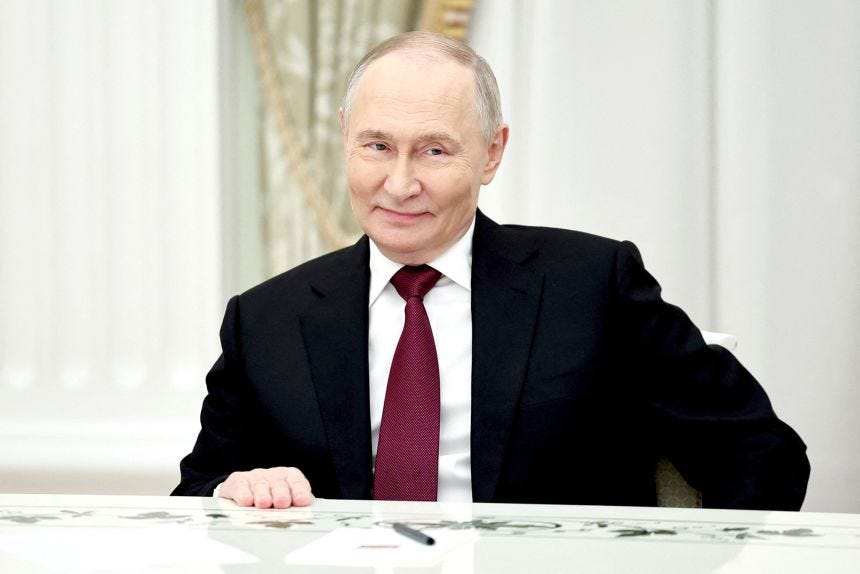
Putin 1.0
From the beginning of President Trump’s second term through the end of 2025, Vladimir Putin operated under what I would characterize as “Putin 1.0.” This version of Putin was overwhelmingly focused on negotiations and on the possibility of improving relations between Russia and the United States. More than anything else, he was determined to give diplomacy every possible chance to succeed.
From Moscow’s perspective, this meant creating opportunities for dialogue, exploring potential areas of agreement, and seeing whether a peaceful negotiated settlement to the war in Ukraine could be achieved. Given the exceptionally capable diplomatic team at Putin’s disposal, led by Foreign Minister Sergei Lavrov, it was entirely reasonable to believe that this approach could bear fruit. If there was a path to a political settlement, Putin seemed intent on finding it.
Throughout 2025, President Putin devoted a considerable amount of time and attention to diplomatic engagement. This included meetings and discussions involving figures such as Steve Witkoff and Jared Kushner, as well as the summit meeting with President Trump in Anchorage, Alaska. These were not symbolic gestures. They reflected a genuine strategy that placed negotiations at the center of Russian decision making.
What stands out in retrospect is that Putin remained committed to this diplomatic track even when it encountered obstacles. Whether diplomatic initiatives were undermined by Zelensky, the Europeans, American neocons or criticized by more hawkish voices at home, he stayed focused on the goal of reaching some form of negotiated outcome. Time and time again, Putin was willing to extend the process, keep discussions alive, and see whether diplomacy could succeed.
This was Putin 1.0: a leader focused first and foremost on diplomacy, committed to testing every available avenue for peace before concluding that the outcome would have to be decided by military means.
Turning Point
On December 29, 2025, a highly consequential event took place that served as a watershed moment initiating the shift from Putin 1.0 to Putin 2.0. Specifically, 91 drones were launched by Ukraine deep into Russian territory. Although air defense systems detected and intercepted all of the drones, preventing any casualties or material damage, the operation’s significance was profound.
Unlike previous drone strikes, this operation targeted Vladimir Putin’s presidential residence in Valdai, located northwest of Moscow. Despite the fact that Ukrainian officials denied that the residence was the intended target, Russian authorities asserted that recovered drone debris provided incontrovertible evidence of the drones’ planned flight paths and objectives.
At the time of the attack, Vladimir Putin was speaking by telephone with President Trump. Although President Trump expressed shock and frustration upon learning of the incident, subsequent Russian assessments concluded that the operation was linked directly to the United States. The impact of the Valdai incident on Putin was transformative.
From Moscow’s perspective, the significance of the attack extended far beyond the immediate military threat. The incident was interpreted not merely as another cross-border drone strike, but as a direct challenge to the personal security of the Russian head of state and as evidence of sinister Western involvement in the conflict.
It prompted a reassessment of Putin’s approach to diplomacy, negotiations with the United States, and the overall assumptions that had guided policy up to that point. In this sense, the attack can be viewed as a defining inflection point that kicked off the transition from Putin 1.0 to Putin 2.0 and ushered in a more military-centric approach from the Russian President.
In the weeks following the attempted attack on the Russian presidential residence in Valdai, Vladimir Putin was noticeably quiet on the topic of Ukraine. The realization that Ukraine had attempted to target his life with American assistance while he was on the phone with President Donald Trump deeply disturbed him. It was as though he needed time to absorb what had occurred and to confront the reality of the situation.
Eventually, what emerged from that silence was what can be termed Putin 2.0.
Join The Duran Community!
Subscribe & Support The Duran
Putin 2.0
Putin 2.0 is genuinely a different Putin from the version that existed throughout 2025. He no longer speaks about negotiations in the same way because he no longer expects meaningful diplomatic progress with either Ukraine or, more importantly, the United States and President Trump. The expectation that the conflict could be resolved through diplomacy has been replaced by a conviction that it will be settled on the battlefield.
As a result, Vladimir Putin is now overtly focused on achieving military victory. This shift in mindset is evident not only in Russia’s actions but also in Putin’s public remarks and interactions. Nowhere was this more apparent than during the Russia Day celebrations on June 12, 2026 when Putin held a meeting with midlevel soldiers serving on the front lines and allowed them to ask questions with a degree of openness rarely seen in Collective West settings.
From the questions and answers that took place on Russia Day, it is apparent that Putin 2.0 is a leader focused above all else on military victory, particularly through the rapid development and production of new weapons, armaments, and military technologies that can produce tangible results on the battlefield. His recent discussions with frontline troops have reflected this priority. Putin has engaged in detailed conversations about everything from handheld, pistol-like net launchers to electric motorcycles customized so that soldiers can move silently along the frontline, to the progress of Russia’s own alternative version of Starlink.
What is striking about Putin 2.0 is the degree to which his attention appears fixed on operational and technological solutions that can improve Russia’s military effectiveness. The focus is no longer on diplomatic maneuvering or negotiations but on identifying the tools, systems, and capabilities needed to achieve victory.
Beyond the battlefield itself, Putin 2.0 has also made clear that he views the territories under Russian control as a permanent part of Russia’s future. Moreover, he has publicly stated that these regions will be rebuilt and brought up to the same standard of living as the rest of the Russian Federation by 2030. Specifically, Putin’s redevelopment plan integrates “approximately 300 different measures, including the development of social, housing, transport, and utilities infrastructure, the implementation of projects aimed at launching new industrial and agricultural enterprises, and the creation of additional modern jobs.”
This is a revealing statement because it provides insight into Putin’s expectations regarding the duration of the SMO. Large scale reconstruction and integration plans assume a level of stability and control that can only come after the war’s major military objectives have been achieved. As a result, Putin’s public comments suggest that he does not view the conflict as an open-ended struggle stretching far into the next decade. Rather, he appears to believe that the decisive phase of the war will be concluded within the next two to three years, allowing Russia to shift its focus from military operations to consolidation and reconstruction.
As far as the United States is concerned, Putin now views negotiations with them as a chapter that has effectively closed. In his view, the United States cannot be trusted, and that President Trump lacks the political strength necessary to confront Ukraine, the Europeans, or even the more hawkish members of his own party. The expectation that Washington could serve as a meaningful negotiating partner has largely disappeared.
Putin’s view of Europe is even more negative. He has concluded that there is no realistic prospect for meaningful negotiations with either the European leadership or President Zelensky. From his perspective, diplomacy with the Europeans offer no foreseeable path toward achieving Russia’s objectives.
At the same time, Putin appears entirely unmoved by Western narratives portraying him as humiliated, Russia as vulnerable to drone attacks, or the war as strategically deadlocked. On the contrary, he projects confidence in the trajectory of the military campaign and appears convinced that Russia is steadily achieving its objectives on the battlefield.
Ultimately, the difference between Putin 1.0 and Putin 2.0 is straightforward. The Putin of 2025 (1.0) believed diplomacy could produce results. He remained open to negotiations and continued searching for a political path to ending the conflict. That version of Putin no longer exists.
Putin 2.0 is focused almost exclusively on winning the war. He has moved beyond diplomacy and has immersed himself in the practical realities of military power. He is personally engaged in efforts to accelerate the development of weapons systems, battlefield technologies, satellite networks, logistics capabilities, and industrial production. His priority is no longer reaching an agreement but ensuring that Russia possesses the tools necessary to achieve its objectives. The defining feature of Putin 2.0 is action, not negotiation.
In terms of justifying the efforts of Putin 1.0, the Russian president does not view the diplomatic outreach of 2025 as a failure. On the contrary, he appears to regard it as a necessary and worthwhile phase of the conflict. From his perspective, those efforts allowed Russia to demonstrate good faith, establish the moral high ground in the eyes of key partners such as China, and provide the United States with every opportunity to step back from deeper involvement in the conflict. By pursuing negotiations as extensively as he did, Putin believes he accomplished everything that could realistically be achieved through diplomacy.
The difference is that Putin 2.0 now appears convinced that diplomacy has reached the end of its usefulness. Having achieved all that could be achieved through negotiations, he has concluded that military engagement on the battlefield is the only remaining path to ending the war and securing Russia’s objectives.
Conclusion
In many respects, the transition from Putin 1.0 to Putin 2.0 mirrors the logic that preceded the special military operation itself. In both cases, Putin’s view is that diplomacy was given every opportunity to succeed, and in both cases, he ultimately concluded that force was the only remaining instrument capable of producing the desired outcome. Seen through this lens, the evolution from Putin 1.0 to Putin 2.0 is not a break in thinking but a continuation of a long-established pattern in his decision making.
“We spent eight years persuading them, do you understand? We didn’t just decide: we woke up, tomorrow we’ll fight. We spent eight years persuading them to negotiate peacefully with this part of Ukraine where Russians live…We waited eight years for a peaceful solution, but then it became clear it was impossible…We had to defend our interests and the people living there by other means.” ~ Vladimir Putin
As you can see from the quote above, Vladimir Putin describes his approach to Ukraine as one characterized by repeated efforts to avoid war. He argues that for eight years he pursued diplomatic solutions and genuinely sought a peaceful resolution, only concluding that military action was necessary after those efforts had failed.
A similar pattern can be seen in his actions throughout 2025. Putin devoted considerable time and attention to diplomacy, negotiations, and the possibility of a political settlement. However, as those efforts failed to produce the results he sought, he arrived at the conclusion that military victory on the battlefield was the only viable path forward.
In both cases, Putin can be seen as a leader who first exhausts diplomatic options before turning to force. From his perspective, military action is not the preferred course but the course adopted when all other alternatives have been exhausted. This continuity in thinking helps explain the transition from Putin 1.0 to Putin 2.0 and why the latter has become so heavily focused on achieving decisive results through military means.
Regardless of one’s views on Russia, the conflict in Ukraine, or Vladimir Putin personally, the transition is impossible to ignore. The Putin who spent 2025 exploring diplomatic possibilities and searching for a negotiated outcome has given way to a leader focused almost exclusively on achieving military objectives. Negotiations are no longer at the center of Russian strategy. Victory is. The defining question is no longer what can be agreed upon across a negotiating table, but what can be achieved on the battlefield. Ready or not, welcome to Putin 2.0.
As always, I thank you all for your continued support and readership.
Until next time,
Jon Kurpis
DISCLAIMER: This article is published strictly in my personal capacity and reflects only my individual views and analysis. Nothing herein should be interpreted as an official statement, communication, or policy position associated with my role as an elected official, any municipality, governmental authority, political party, or affiliated public institution. Furthermore, the perspectives expressed do not necessarily reflect the views or positions of The Duran.
Thanks for Reading!
Feel Free to Share, Comment and Subscribe!
President Putin is the greatest leader of the 21st century. Nobody else comes even close. It is a tragedy for the West that he has been so maligned and misunderstood, on purpose. Notice that I said, for the West. The rest of the world, the global supermajority, gets it. As time passes we will realize that what the West thinks is insignificant, as is the West itself. The West is really just the US, and the US sits on an isolated continent as the real world passes it by. Geography is fate. It should be obvious now that the US cannot effectively project either military or economic power. Thank you Donald Trump!
It's a bit puzzling… History shows how the US has lied about almost everything… Vietnam, Cambodia, Iraq, Iran, Iran-Contra, Libya, Israel, Bosnia, Afghanistan, Pakistan, China, Syria, Venezuela, Cuba, Philippines, fishing boats in the Pacific, (the list just goes on and on) and damn near everything domestic. All lies and propaganda, year after year, with the mainstream media serving up stenographic services for the deep state. Lies and propaganda… and yet we accept and believe every word the government spews about Russia and Putin. Lies about everything else, but on Russia, nothing but the truth. Puzzling, indeed!