


As Ukraine’s economy buckles and Patriot stocks run thin, Europe confronts the financial and strategic cost of a war it can neither sustain cheaply nor end on its own terms.
Power is ultimately measured by the ability to impose costs while continuing to absorb them. For much of the Ukraine war, Europe assumed that economic pressure would steadily narrow Russia’s options. Sanctions would weaken Moscow, alternative energy supplies would protect European consumers, and Western military support would allow Kyiv to sustain the conflict until diplomacy became unavoidable.
The opposite dynamic is now taking shape. Russia continues to impose costs across several connected fronts: energy, infrastructure, trade, military inventories and diplomacy. Europe, meanwhile, is discovering that replacing dependence is not the same as eliminating it. Russian pipeline gas has been exchanged for a more expensive and less predictable energy system, while the effort to sustain Ukraine increasingly draws upon financial and military resources that cannot be replenished quickly.
This is not simply an energy crisis or an ammunition shortage. It is the accumulated bill for a strategy built on the assumption that time would work against Moscow.
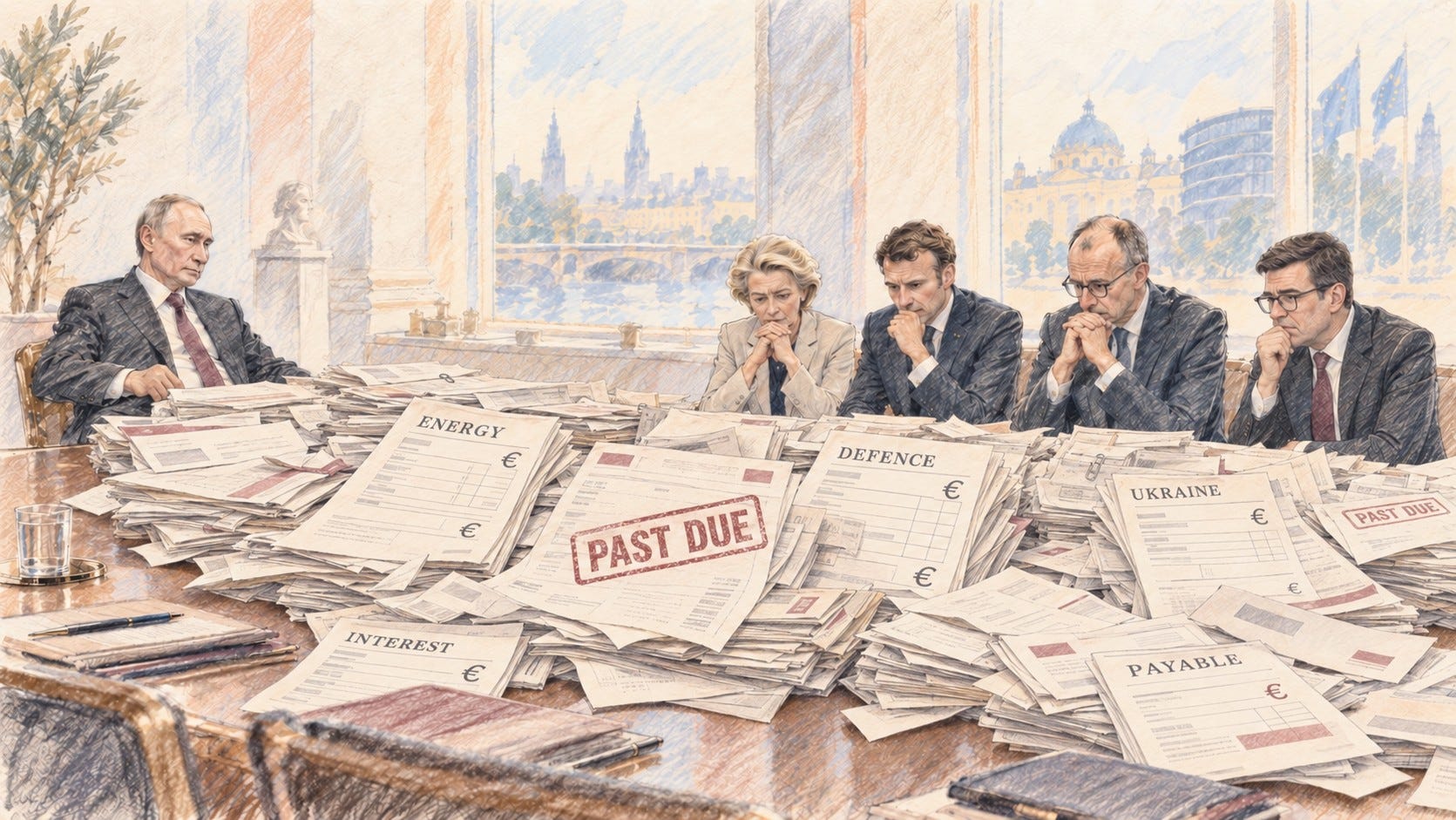
The Energy Reckoning
Vladimir Putin’s latest comments on European gas prices were intended as more than an exercise in vindication. Russia once supplied gas to Europe for roughly $150–$180 per thousand cubic metres under long-term contracts linked to oil prices. European policymakers repeatedly pressed for a greater role for exchange-based pricing, believing a more liberalised market would deliver competition and lower costs.
Putin’s argument is that gas was never an ordinary commodity. Its price reflects pipelines, storage, transport capacity and long-term supply relationships that cannot be replaced at will. Europe gained flexibility by diversifying away from Russian pipeline gas, but it also accepted greater exposure to global demand, liquefied natural gas costs and seasonal volatility.
With storage levels under pressure, Putin now claims prices approaching $1,000 could rise toward $1,500 during the winter. Whether that forecast proves accurate is less important than the vulnerability it exposes. Europe has reduced Russia’s position within its energy system, but it has not created abundant cheap energy to replace it.
The continent has exchanged one form of dependence for another—at a substantially higher cost.
A War Against Economic Circulation
The same logic is visible in Russia’s expanding air campaign against Ukraine. Reports cited in today’s analysis describe a strike involving roughly 800 drones, targeting fuel stations, railway infrastructure and military facilities across the country, including areas in western Ukraine.
The choice of targets matters. Fuel distribution and rail networks are not merely supporting elements behind the battlefield. They are the circulatory system of the Ukrainian state. Damaging them raises the cost of moving troops, sustaining industry, supplying cities and preserving what remains of normal economic activity.
Ukraine is reportedly spending about $190 million a day on the war. Russian pressure on its Black Sea ports places as much as $40 billion in export revenue at risk, particularly from agriculture, iron and steel. Kyiv may also require approximately $90 billion to repair its damaged energy infrastructure.
These figures cover different periods and categories, but together they describe an increasingly severe imbalance. Ukraine must finance the war, repair the country and protect the economic activity required to pay for both. Russia does not need to destroy every target. It needs only to ensure that the cost of maintaining the system rises faster than Kyiv and its supporters can finance it.
Join The Duran Community
Subscribe and Support The Duran!
The Arithmetic of Scarcity
Ukraine’s search for Patriot interceptors reveals the military side of the same problem. Zelensky says Russia can produce around 140 ballistic missiles each month and estimates that Ukraine needs between 100 and 120 Patriot interceptors for the difficult winter period.
The problem is no longer simply whether Western governments are willing to provide them. It is whether sufficient interceptors exist.
American production remains limited. Middle Eastern governments face their own security requirements. European states are being urged to transfer existing Patriot systems and wait for future replacements, effectively accepting a temporary reduction in their own defensive capacity to preserve Ukraine’s.
This is where political commitments collide with industrial reality. Money can authorise an order, but it cannot instantly manufacture an interceptor. Europe’s governments are being asked to exchange present security for promised future production at precisely the moment when their own warnings about a Russian threat are becoming more urgent.
The contradiction is difficult to conceal: Europe describes Russia as an immediate danger while considering the transfer of the weapons intended to defend against it.
Time Changes the Terms
Diplomacy is also being shaped by this balance of endurance. Moscow says it remains open to a trilateral meeting involving Putin, Zelensky and Donald Trump, but insists that Zelensky travel to Moscow. The Kremlin has ruled out such a meeting at the G20 summit in Miami.
The venue is part of the negotiation. Requiring the Ukrainian president to come to Moscow would present any meeting as an acknowledgement of where the strategic initiative now lies.
Jared Kushner’s assertion that much of a peace agreement has already been drafted sharpens the issue. According to his account, the principal unresolved obstacle is Ukraine’s withdrawal from the Donbas—something Zelensky continues to reject.
Kyiv’s objection is understandable. Yet time is not preserving the current offer. If Russia takes the remaining Ukrainian-held territory militarily, Moscow will have little reason to retain terms designed to secure through negotiation what it has already obtained on the ground.
The energy dispute and the peace negotiations therefore carry the same warning. Decisions deferred in the expectation of better conditions can produce fewer choices and a higher eventual price.
Europe’s difficulty is not that collapse is imminent. It is that the resources required to sustain its strategy—cheap energy, industrial capacity, air-defence inventories and political cohesion—are becoming scarcer while Russia’s leverage continues to accumulate. Strategic autonomy cannot be declared at a summit. It must be provisioned, financed and defended.
Please share with your friends, leave a comment, and subscribe!
Thank You for Supporting The Duran!
The decision by western governments to outsource their manufacturing decades ago is finally biting them in the ass. I'm convinced that the political class and the donor class who contol them have proved once and for all their utter incompetence and lack of long term planning. These morons are trying to solve a self inflicted problem with a war they can neither supply or fund. I'm flabbergasted at the amount of copium being thrown around, especially in Europe. Excellent article by the way. 👍
Thank you for an excellent and well written summary.