

Washington’s attempt to isolate Iran is becoming a test of whether dollar power can still compel economic alignment in a more fragmented world.
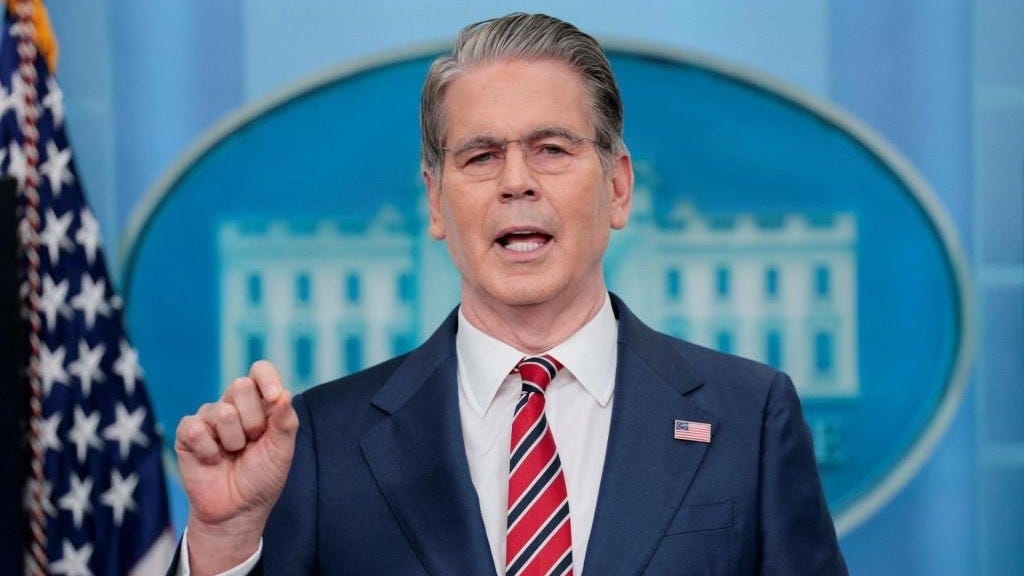
Scott Bessent has given Washington’s latest Iran strategy an unusually precise objective: “zero leakage.”
Under Operation Economic Outcast, the United States intends to close the channels through which Iran continues to trade, finance imports and exports, move money and maintain links with the wider global economy. Bessent describes an economic campaign designed to sever Iran’s remaining financial lifelines. Countries that cooperate with Washington can expect the benefits of partnership; those that continue facilitating Iranian commerce risk secondary sanctions and exclusion from the dollar system.
The objective appears straightforward. Its implications are considerably larger.
Washington is attempting to use its control over the central infrastructure of international finance to transform American sanctions from a national policy into a global obligation. Whether that works will depend less on Iran than on the countries being asked to enforce it.
And that means China.
The Dollar as an Instrument of Alignment
Bessent’s strategy rests on an enormous American advantage. The dollar remains central to global finance, trade settlement and banking. Access to that system gives Washington leverage extending far beyond its own borders.
Secondary sanctions exploit precisely that leverage.
A Chinese refinery, Turkish bank or Asian shipping company may have no legal obligation under its own national laws to respect American sanctions against Iran. But Washington can confront it with a different calculation: continue dealing with Iran and potentially lose access to American markets, banks or dollars.
For decades, that choice has often been enough.
Operation Economic Outcast attempts to push the principle much further. Treasury says it has mapped the networks Iran uses to evade sanctions and is demanding corrective action from foreign governments and institutions. Bessent has promised a “zero-leakage approach,” while warning that entities facilitating Iranian financial activity could be removed from the U.S. dollar system.
But zero leakage requires something approaching universal compliance.
That is where sanctions policy becomes a geopolitical test.
China Is the Real Test
China is not simply another Iranian trading partner. It is a major economic power with the capacity to absorb retaliation, develop alternative channels and challenge Washington’s claim to determine how third countries conduct lawful trade.
Beijing generally recognizes sanctions authorized through the United Nations Security Council. It has consistently rejected the principle that unilateral American sanctions should determine Chinese foreign economic policy.
If Chinese companies continue purchasing Iranian energy, Washington therefore faces an uncomfortable choice.
It can tolerate leakage, undermining the central promise of Bessent’s strategy. Or it can escalate against larger Chinese banks, companies and trading networks, potentially turning an Iran sanctions campaign into another confrontation between the world’s two largest economies.
This explains the most revealing qualification in Bessent’s announcement.
Asked why Washington was not immediately imposing its toughest penalties, he replied: “Why would I want to blow up the global financial system?” The administration is instead providing a period in which governments and companies can adjust their behavior.
That answer exposes the constraint at the center of the policy.
The more powerful the target, the more expensive enforcement becomes.
Join The Duran Community
Subscribe and Support The Duran!
The Paradox of Financial Power
American financial power works because access to the dollar system is valuable. But repeatedly turning that access into an instrument of coercion also gives other governments a reason to reduce their dependence upon it.
Russia has already been pushed substantially outside Western financial infrastructure. China has spent years expanding renminbi settlement, bilateral payment arrangements and alternative financial channels. BRICS governments have openly discussed reducing vulnerability to Western sanctions.
None of this means the dollar is about to disappear as the dominant global currency. It means something more gradual and strategically important: governments now have an additional incentive to construct mechanisms that make American financial pressure less effective the next time it is applied.
This is the paradox of Operation Economic Outcast.
The United States is attempting to demonstrate the extraordinary reach of the dollar at precisely the moment when that reach is encouraging some of its largest competitors to seek alternatives.
The more comprehensive “zero leakage” becomes, the stronger that incentive becomes.
From Iranian Pressure to Systemic Pressure
The immediate American objective is Iran. The larger objective is behavioral: Washington wants countries to conclude that preserving access to the American financial system matters more than maintaining economic relations with Tehran.
If that calculation holds, Bessent’s strategy could sharply constrain Iran without requiring a much larger military commitment.
But if China refuses, the question changes.
Washington would then have to decide how much disruption it is prepared to impose on the international economy to defend the credibility of its sanctions. Beijing would have to decide how much cost it is prepared to absorb to defend its economic sovereignty. Other governments would watch closely, because the precedent would extend far beyond Iran.
This is why Bessent’s comments matter more than another sanctions announcement.
They reveal an American strategy increasingly dependent upon economic statecraft at a time when the international system is becoming less willing to accept economic alignment automatically.
The United States still possesses immense financial leverage. The question is no longer whether Washington can use it.
The question is how often it can compel the rest of the world to comply before that leverage begins changing the system it was designed to control.
Please share with your friends, leave a comment, and subscribe!
Thank You for Supporting The Duran!
CIPS is not SWIFT. CIPS is a settlement system which also transmits information and data. SWIFT is a transmission system of data , a messaging system. It does not settle, the USD settlement system is CHIPS.
CIPS settles the equivalent of $27 billion a year and is growing at 40% a year. Many more countries in the world have China as its no1 trading partner than the US. On top of this is mBridge which links the central banks using digital currencies now up to $66/yr. There was a day in April when settlement through CIPS exceeded CHIPS.
And the icing on the cake and rarely discussed is the ability of counterparties to use the HK and
Shanghai bourses to convert their traded yuan into Gold. Thus removing a perceived barrier of trade due to the yuan's non convertability.
This has all been tested under pressure in the last 6 months of the US/Iranian war. It easily passed.
This does not mean the dollar will not continue to be used for settlement , but it does mean it can be bypassed in a tried and tested system, Bessent has already lost.
excellent