


Hormuz, Europe’s energy vulnerability and the Ukraine war are exposing the same problem: geopolitical commitments are colliding with the material systems needed to sustain them.
Great powers rarely discover the limits of their strategy at the negotiating table. They discover them in fuel depots, industrial plants, shipping lanes, air-defense inventories and balance sheets.
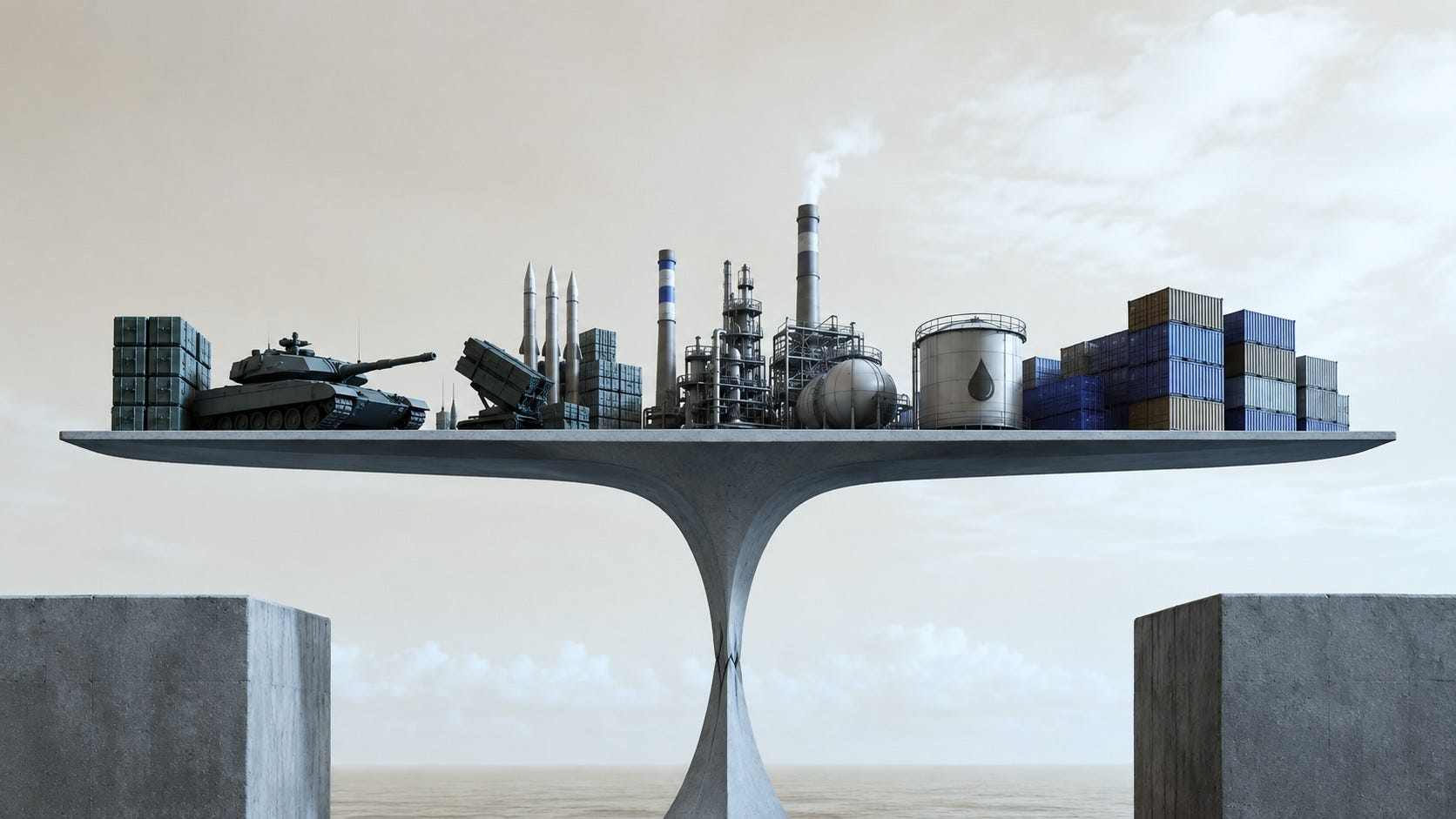
The international system is entering precisely such a moment. Governments that have spent years expanding their geopolitical commitments are confronting a less forgiving constraint: the physical capacity required to sustain them. Energy must still be transported. Weapons must still be manufactured. Factories must remain competitive. Supply chains must survive disruption. Strategic autonomy ultimately depends on material resilience.
That gap between ambition and capacity is becoming increasingly difficult to conceal.
Energy Is Strategic Power
The continuing closure of the Strait of Hormuz illustrates the problem most clearly.
Iran’s ability to keep one of the world’s most important energy corridors closed gives Tehran leverage far beyond the immediate battlefield. The consequences are already moving through oil, natural gas, diesel and aviation-fuel markets, even if the dramatic crude-price shock originally anticipated has not yet appeared.
The more consequential test may come later.
Europe enters the approach to winter with reported German gas storage levels around 50 percent, well below the levels normally expected at this point in the year. LNG cargoes are being pulled toward Asian markets, while American gas consumption is also increasing. Japan faces a similar structural problem: extraordinary dependence on imported energy combined with deteriorating relations with Russia, the major energy producer sitting almost directly across its northern maritime frontier.
These are not merely energy-market problems. They are questions of industrial power.
Energy-intensive industries cannot remain globally competitive indefinitely if their input costs structurally exceed those of their competitors. What begins as a geopolitical confrontation can therefore become an industrial restructuring. Households experience the process as inflation. Companies experience it as margin compression or closure. States eventually experience it as diminished strategic capacity.
Europe and Japan may discover that energy security is not one component of national power. It is the foundation beneath much of it.
The Industrial Base Becomes the Battlefield
The same logic is increasingly visible in Ukraine.
Kyiv’s latest attacks reportedly involved roughly 2,100 aircraft-type drones and around 30 Flamingo cruise missiles over 48 hours. The scale is impressive. The more important question is what that expenditure produced.
Some targets were hit, including facilities around Moscow and industrial sites deeper inside Russia. Yet evidence of strategically significant damage remains limited. Large industrial complexes can disperse production, absorb damage and repair facilities. Logistics operators can decentralize warehouses. The cost of forcing temporary disruption may therefore rise faster than the military value generated.
Russia’s reported targeting pattern points toward a different calculation.
Strikes have focused on Ukraine’s refinery infrastructure, steel production, defense-industrial facilities and sites connected to missile production. Meanwhile, Russian Geran drones are reportedly receiving more sophisticated electro-optical sensors, onboard computing and digital communications, potentially improving their ability to identify and track targets during the terminal phase.
The contest is therefore moving beyond simple numbers of missiles and drones.
It is becoming a competition over industrial replacement rates, target value and cost exchange.
In a prolonged conflict, spectacular attacks matter less than whether one side can systematically degrade the systems that allow the other to continue fighting.
Join The Duran Community
Subscribe and Support The Duran!
Escalation Without Autonomy
Europe’s difficulty is that its political strategy continues to expand even as its underlying vulnerabilities become more apparent.
Britain is reportedly supplying jet-powered drones that have been used for strikes deep inside Russia. Poland intends to build a force potentially reaching 300,000 personnel by 2030. Germany is discussing the creation of Europe’s largest conventional military. Turkey has approved another substantial weapons transfer to Ukraine.
Europe is simultaneously preparing for negotiations and preparing for a larger military confrontation.
That is not necessarily contradictory. States frequently negotiate while strengthening their military position. But it becomes problematic when the industrial and energy foundations supporting that posture are themselves under pressure.
The deeper question is therefore not whether Europe can increase defense spending. It clearly can.
The question is whether Europe can rebuild military capacity while absorbing higher energy costs, sustaining increasingly vulnerable industries and financing expensive social systems at the same time.
Defense budgets measure expenditure. Strategic power measures what that expenditure can actually produce and sustain.
Material Reality Returns to Diplomacy
This may explain why battlefield developments and European diplomacy are beginning to converge.
Berlin, Paris and London are reportedly pressing Washington to restart negotiations with Moscow before winter even as European governments insist that Ukraine and Europe must be represented in any settlement process.
The timing matters.
Negotiations pursued when military prospects are improving carry one meaning. Negotiations sought as air-defense inventories tighten, energy insecurity grows and battlefield pressure increases carry another.
Russia will judge Western diplomatic initiatives against those material conditions, not against declarations of neutrality or carefully constructed distinctions between American and European policy.
And that points toward the larger transformation now taking place.
For three decades, Western strategy operated in an international environment in which access to energy, industrial inputs, finance and global transportation could largely be treated as background conditions. Those assumptions are disappearing.
Hormuz demonstrates the power of chokepoints. Ukraine demonstrates the importance of industrial depth. Europe’s rearmament demonstrates the enormous cost of rebuilding military capacity after decades of contraction.
The international system is becoming material again.
In that world, strategic ambition will increasingly be judged not by what governments promise, threaten or announce, but by something much simpler: what their economies can sustain.
Unlock Great Savings on The Duran Merch

Please share with your friends, leave a comment, and subscribe!
Thank You for Supporting The Duran!
Very good article. Thanks Duran!
Are there sources of oil and gas in the United States and in Europe that are not dependent on the Middle East? Why are they dependent on the Middle East? Why don't the United States and Europe focus on energy instead of on war? Why doesn't the United States leave Iran alone? The elites have no allegiance to the United States or to Europe.