

With Friends Like These...
The inside story of how Washington tried (and failed) to draw Georgia into a war with Russia.

Authored by Paul Grenier…
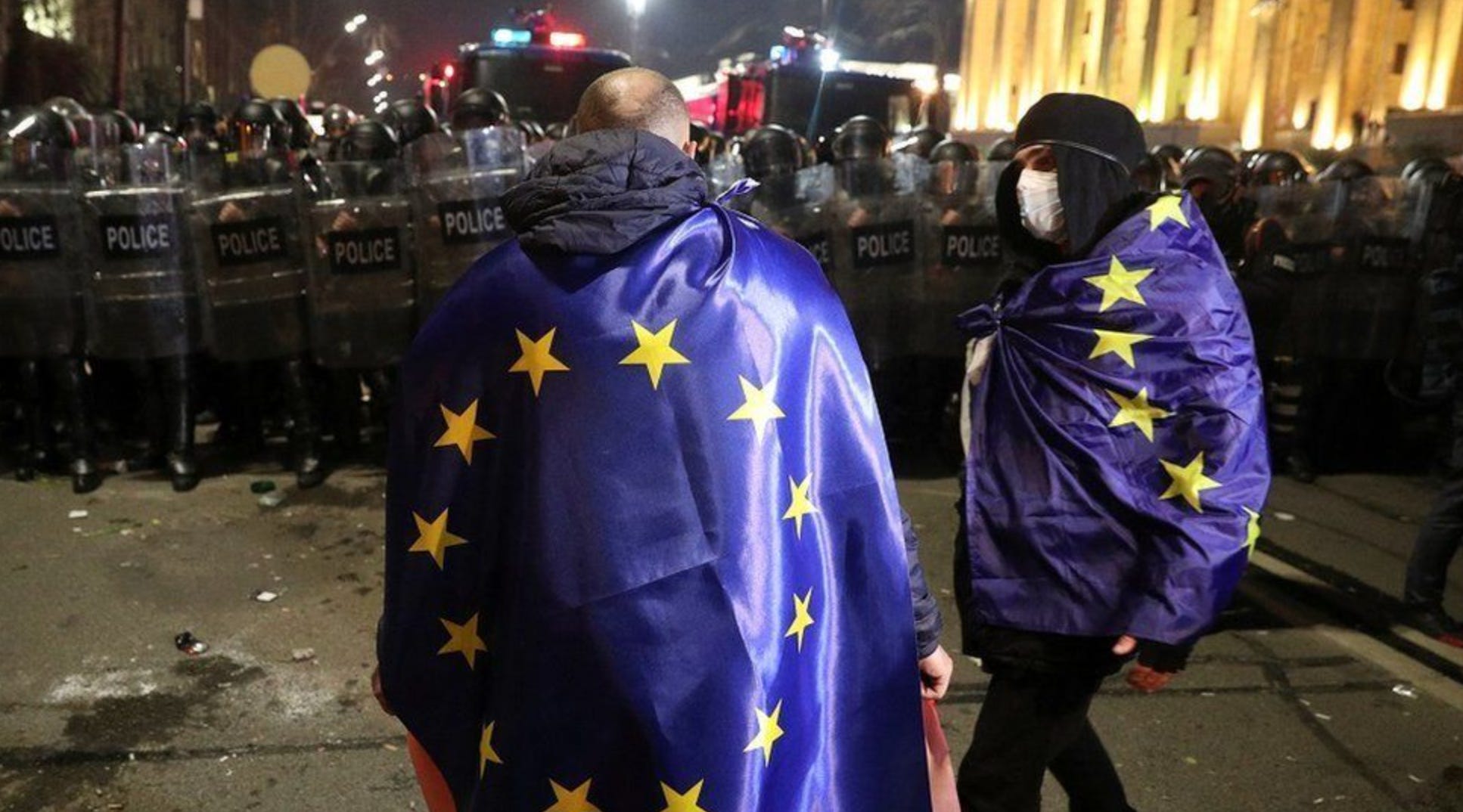
It is perhaps only natural that the tiny Republic of Georgia should have fallen out of the news cycle in the U.S. The flashy protests in downtown Tbilisi have long since petered out. The Georgian Dream government – the very government against whom the NGO-organized crowds had been protesting -- remains stably in power. Meanwhile, there has been one crisis after another, from Venezuela to Greenland to Iran.
And let’s be honest: to most Americans, tiny Georgia just doesn’t matter very much. As so often happens, though, the United States very much matters to Georgia.
Case in point: as punishment for the country continuing to do business with Russia and China, the U.S. Congress, by means of the so-called Megobari Act (the word ‘megobari’ in Georgian means ‘friend’) is likely to soon place the Georgian government under sanctions.
The threat of such sanctions, or rather, the threat of getting on ‘the sanctions escalator’ as the foreign affairs analyst Alexander Mercouris likes to put it, could easily intimidate a small country like Georgia and cause it to change course. And yet, for now at least, Georgians are doing the opposite. They are insisting that it is they who have been ill-used, and they are gradually distancing themselves from Washington as a result.
How has Georgia been ill-used? Georgian officials and experts claim that after Russia’s invasion of Ukraine in November 2022, the U.S. pressured their tiny Caucasus nation of 3.8 million to confront Russia militarily. These officials have stated that they were urged to open a second front against Russia from the south, and pressured to transfer vital weapons systems to Ukraine. All this amounted, from the Georgian perspective, to their being asked to commit suicide.
These claims have been roundly dismissed as ridiculous by the U.S. officials involved, as well as by such outlets as The New York Times. And yet the evidence for the Georgia version of the story is well worth taking seriously, all the more so as, in recent months, credible Georgian voices have provided important additional detail.
The notion that Washington, in the wake of the Russian invasion of 2022, urged Georgia to confront Russia militarily has been denied by the U.S. ambassador at the time the Ukraine war broke out, Kelly Degnan. It has also been denied by the Hudson Institute’s Luke Coffey during Congressional testimony. And it has been subjected to ridicule by The New York Times.
Indeed, in his lengthy Times essay, author Scott Anderson wrote sarcastically about talk in Georgia about some sort of Western ‘global war party’ urging Georgia to open up a second front against Russia “and in that way to seal its own doom.” Significantly, Anderson questioned the plausibility of claims made by Georgian Prime Minister, Irakli Kobakhidze, that it was indeed true Western officials had urged such a course, but out of national security considerations he couldn’t say who it was. Today those considerations, apparently, no longer apply. Georgians are naming names. Among them: Kelly Degnan.
The first instance of pressure on Georgia – and, specifically, on the king-maker Georgian billionaire, Bidzina Ivanishvili -- concerned BUK anti-aircraft missiles. I learned of the US ambassador’s pressure on Ivanishvili from a highly credible source: Petre Mamradze.
Mamradze, a doctor of theoretical physics and mathematics, served, among other high government posts, as head of the Georgian State Chancelry across several administrations, from 2003 – 2012. (It was also Mamradze who, after the collapse of the USSR, helped secure uranium supplies and worked with the U.S. to get them out of the country to a secure location.)
That the US would be interested in sending Soviet-era BUK anti-aircraft missiles to Kyiv is easy to understand. They are effective, and already familiar to the Ukrainian military.
According to Mamradze’s account, a few days after Russia’s invasion of Ukraine, Ivanishvili discovered that, without any explanation or any charges having been brought against him, his considerable financial assets held in Western financial institutions had been frozen. Mamradze further states that, almost simultaneously with this discovery, Amb. Degnan requested a meeting with Ivanishvili, and they then met on March 21, 2022. At that meeting, Ambassador Degnan told Ivanishvili to see to it that Georgia's BUK air defense missiles and Javelin anti-tank weapons were transferred to Ukraine.
Ivanishvili responded that he considered this request to be, at the very least, dishonorable, especially given that the West had just frozen his financial assets. Ivanishvili reportedly described the request as tantamount to blackmail, aside from being insane: it would leave Georgia defenseless and “naked” against Russia, whose tanks are located about two hours’ drive from Tbilisi. In the early days of the Ukraine war, however, Ivanishvili did not publicly come forward about this incident -- at least, not in public.
Anatol Lieven, in a published account of his Sept. 30, 2025, conversation with Georgian president Kavelashvili, points out that Georgia went to considerable lengths to prevent Georgian volunteers from going to Ukraine to fight and had also rejected Western pressure to send Kyiv military aid. What is more, and to Western chagrin, the Georgian government rejected Western efforts to force Georgia to impose the full range of EU sanctions on Russia. All the above led, Lieven observed, to accusations against Georgian Dream leaders that they were “pro-Russian.”
In his heated response to this charge, Kavelashvili told Lieven:
…The West demanded that we get involved in war with Russia against our vital national interests…just like in 2008, when the then government’s unreasonable actions on the basis of trust in NATO led Georgia to disaster … but today, Georgia has a government that represents the interests of our people…the same media outlets that accuse us of being under Russian influence tell the same lie about President Trump.
Since this September 2025 conversation, circumstances in Georgia have changed in such a way as to make possible greater public openness about who it was that was pushing the country into a confrontation with Russia, even to the point of opening up a second front. Back in spring 2022, Georgian Dream considered the U.S. its ‘strategic partner.’ The public revelations about how Georgia has been treated, however, have put that relationship in doubt.
Thus, to the account provided earlier by Bidzina Ivanishvili about Western pressure to open a second front, we can now add a December 2025 press conference during which Georgian Prime Minister Irakli Kobakhidze stated that he was present at two meeting in February, 2022 -- one in early February, the other on February 27 or 28 th -- at which US Ambassador Degnan was present. At these meetings, says Kobakhidze, the Georgian government was pressured to not only implement anti-Russian sanctions, but to also open up a second front. When the Americans were asked about what would happen if, or rather, when, Russian troops occupied the country, the Georgians were told that they could start a guerilla war of resistance in the forests, and that the Americans would support them. During this interview, Kobakhidze said he did not wish to say specifically which of the Americans present at the meeting had told them to do these things, but he did insist that the US ambassador was present.
Is the above account complete and accurate? It is difficult to say with complete certainty. As we have noted, it has, after all, been contradicted by mainstream sources in the West. And yet the credibility of those Western sources has itself been seriously undermined by accounts such as those of former State Department official Michael Benz. Western reporting – exactly as illustrated by the above-referenced New York Times article – often consists of a kind of circular reasoning whereby Western-financed NGOs on the ground, whether in Georgia or in some other foreign country, repeat back to American reporters more or less exactly what the Western governments that pay their NGO salaries want them to say. Not the most scientific methodology for arriving at the truth of anything.
And so, whether definitively proven or not, the Georgian account detailed above remains highly credible. Indeed, it fits a long-standing pattern. Consider Ukraine. Can anyone doubt that Ukraine would be far better off if, in 2008, the U.S. had not started its obsessive drive to bring that unfortunate land into a military alliance hostile to Russia? By insisting on that policy for so many years, Washington has demonstrated remarkable indifference to the welfare of Ukrainians.
Why should Georgians expect any better?