


Jon Kurpis is an elected official, writer, and entrepreneur dedicated to advocating for everyday citizens. Known for his independent mindset and principled approach, Kurpis is respected for holding those in power accountable. His background in government, policy, and geopolitics makes him a trusted voice on complex political and cultural matters. He is a Contributing Analyst for The Duran Daily. More of his work can be found on his Substack, kurpis.substack.com.
Over the past year, there has been substantial deliberation as to why Russian President Vladimir Putin has been so calm and generally non reactive to the Ukrainian drone strikes within Russian territory. To be clear, these strikes are not one off incidents or accidental. They are calculated assaults that have been aimed at non-military infrastructure and killed civilians including children. There are many Russian people who believe a more aggressive response is in order and it’s not an unreasonable position for anyone to take.
I, myself, have written about this dynamic in the past, and there is no shortage of commentary from others as well. The explanations for the Kremlin’s reaction range from the ridiculous (i.e. Putin is weak or Ukraine is overwhelming the Russian military) to the more intelligent. In regard to assessments aligned with reality, these include the fact that Putin understands that these attacks are not going to derail the outcome of the SMO and are therefore seen as a Hail Mary attempt by the collective West to change the narrative and somehow provoke Russia into an escalation that will either trigger Article 5 or carry some sort of negative military consequence for them. Whatever the truth behind Putin’s motivation may be, it can be said with absolute certainty that the Russian response is not due to an extraordinary military or drone campaign that Ukraine is waging successfully. Rather, it aligns with a calculated response signaling that the Russians will not take their eyes off the ball.
Like others who dabble deep in the world of geopolitical affairs, I monitor the war in Ukraine on a daily basis. Since my last article about this subject published on The Duran Substack on July 19th, 2026, there have been subsequent attacks by Ukraine on non-military facilities (within pre-2014 Russian borders) that have resulted in civilian deaths. While Russia is objectively waging an increasingly aggressive war on the Ukrainians, as can be seen through the blockade of the port of Odessa and the continual pounding that Kiev is taking, there is no overreaction to these Ukrainian provocations. Therefore, the question I find myself asking is whether there is anything else that could be playing a role in this non-reactionary policy. I can’t help but feel that there must be a deeper element of the story that is, in all likelihood, influencing Putin and Russia behind the scenes. After spending considerable time reviewing and analyzing every bit of open source intelligence at my disposal, I have concluded that a missing piece of the puzzle is the ongoing prospect of Ukrainian terrorism itself.
Ukraine Terrorism 101
Since the beginning of the special military operation in February 2022, and even going back as far as 2014, the Ukrainian government has demonstrated through its actions a willingness to engage in dirty war tactics that can accurately be classified as deliberate acts of terrorism. President Zelensky has even shown an eagerness to go far beyond what the Russians appear willing to do, particularly when it comes to attacks on Kremlin leadership and also innocent civilians.
Examples of Ukrainian terror plots are public and numerous. On August 20th, 2022, a fatal car bombing killed the daughter of prominent Russian far-right philosopher Aleksandr Dugin. On April 2nd, 2023, a bombing at a cafe in Saint Petersburg, killed Russian military blogger Vladlen Tatarsky and injured 42 others. A month later, on May 3rd, Ukrainian drones targeted and struck the Kremlin. On June 6th, 2023, the Nova Kakhovka Dam was destroyed in an explosion that resulted in a massive humanitarian and environmental disaster that Russia blames on Ukraine. Between May 31st and June 1st, 2025, strikes on bridges in the Kursk and Bryansk killed eight people. On December 29th, 2025, 91 Ukrainian drones targeting President Vladimir Putin’s Valdai residence were shot down by Russian air defense systems. On May 22nd, 2026, a drone strike on a dormitory in Starobilsk killed 21 people including innocent students. On June 17th, a bus carrying a Belarusian children’s football team was struck by a Ukrainian drone in Bryansk, killing one person and injuring six others. On August 1st, a bombing targeting a Russian military figure at an Italian restaurant in Moscow killed five people and injured 19 others. Two days later, on August 3rd, an attack on a beach near Gelendzhik killed seven people, including three children. It should be noted that this attack is close in proximity to a hotel complex that the collective West erroneously attributes to being a palace for President Putin and a connection between the August 3rd attack and this facility should not be ruled out. Lastly, Wildberries, the Russian equivalent of Amazon, have had it’s facilities struck at least 25 times between July 18th and August 15th, 2026.
While this is nowhere near an exhaustive accounting of all Ukrainian attacks against Russia, what has been demonstrated is a consistent pattern by the Ukrainians to resort to grotesque tactics and outright terrorism targeting innocent civilians as well as a desire to assassinate Vladimir Putin himself. No matter how one may interpret the war in Ukraine, terrorism is a legitimate, ongoing threat to Russia and a very real concern that the Kremlin must account for.
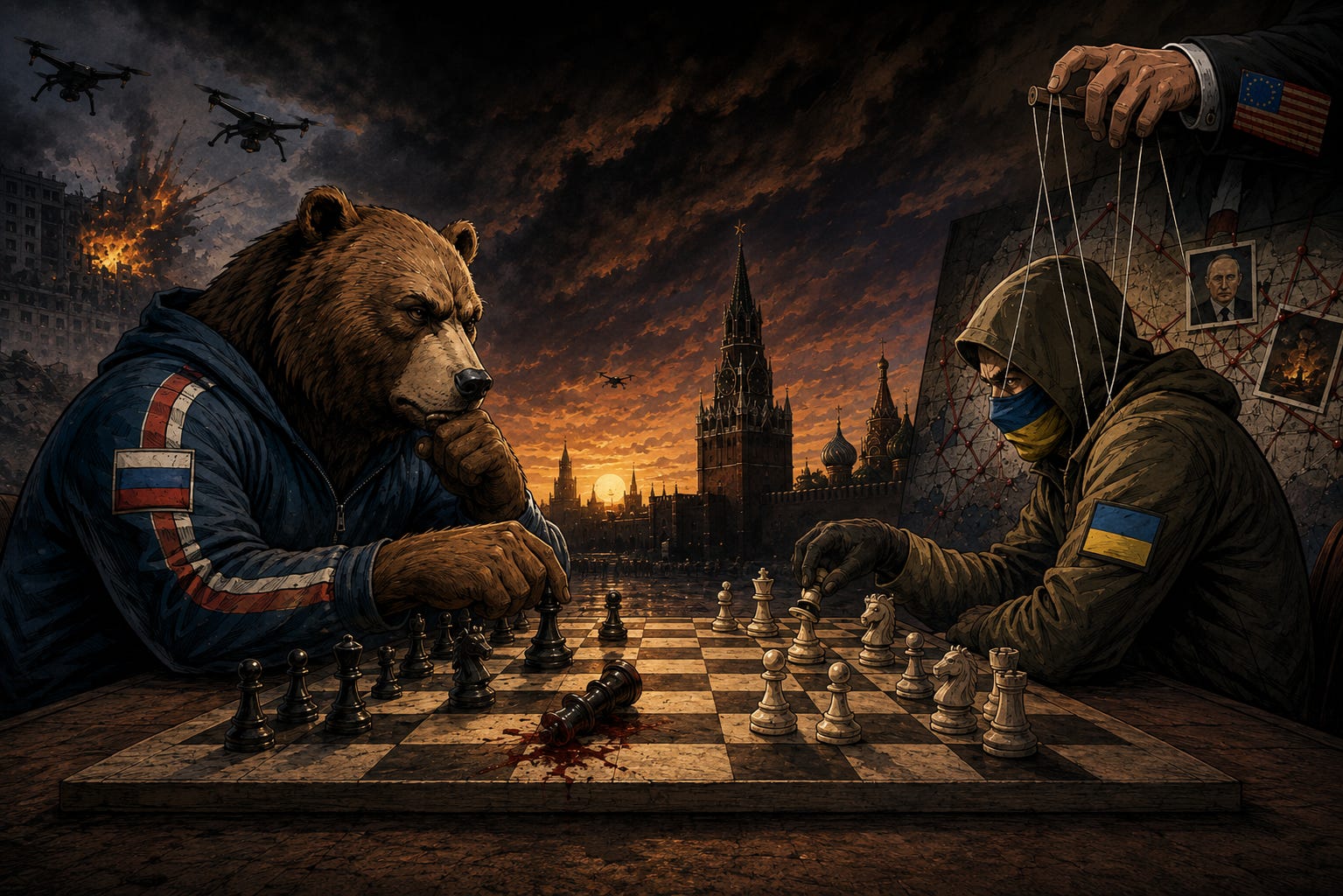
Putting the Pieces In Place
From this vantage point, and in relation to where the SMO currently stands, President Putin has a difficult issue to contend with. On one hand, Russia is closing in on a military win. While total victory still remains months, if not over a year, away, Russia has upped its pressure considerably, and the Ukrainians are starting to read the writing on the wall. This, however, does not lessen the danger for Russia, as cornering the opposition in war is also a precarious position to be in.
This is due to the fact that in adversarial circumstances where one side is about to lose, whether it be in war, politics, or sport, participants will often behave in an unbelievably aggressive manner in an effort to make a formidable final stand. It is often so intense that the winning side gives up not knowing how close they actually were to victory. This is encapsulated by the adage that warns people not to “Give up an inch from the goal line.” In other words, when your side is about to win, things often become so difficult and chaotic that you need to take precautions to prevent it from slipping away due to an inability to withstand the onslaught from the person or entity who is about to lose.
The reason why this is relevant to our discussion is because there is perhaps no example where a losing side is more likely to act in such a reactionary and aggressive, terroristic manner than Ukraine. This unfortunate reality is supported by a documented history from 2022 through the present day that shows that Ukraine is willing and able to exact retribution in a manner that far exceeds anything that is legal or acceptable. This criminal behavior has already occurred, is currently happening, and will become dramatically worse as Russia nears the final days of the SMO.
It is important to consider that just as triggering Article 5 could theoretically derail an otherwise inevitable win for Russia, Ukrainian terrorism, if done on a more robust and deadly scale within Russia, could also become similarly problematic.
If terrorism backed by Ukraine were to regularly result in a large number of deaths, the degradation of critical infrastructure, or the demolition of historically important landmarks, the Russian people would demand that Putin direct the military to take immediate measures to force an end to the SMO. This would require Putin to sign off on overwhelming, big arrow military offensives in Ukraine, and in the process, Russian units would take tremendous losses.
The Russian peoples more aggressive disposition regarding the SMO is not merely speculation. When one looks at the current elections that will take place in Russia in September, it is worth noting that the 2 opposition parties most likely to pick up wins share the position that Russia should be taking a harder approach towards Ukraine. Regardless of the election results, it is clear that the people are trending towards demanding a more overwhelming military campaign and this will definitely increase if acts of terrorism become more commonplace.
It is therefore a genuine risk that Ukrainian terrorism, if managed improperly by Russia, could become a mechanism that interferes with the normalcy that’s been established and ultimately influence the manner by which the special military operation is prosecuted.
President Vladimir Putin and the Russian military are fully aware of this. They are also realize that Ukrainian backed terrorism on Russian soil is a long-term problem that must be dealt with. The genie is out of the bottle, and nobody can put it back in. That said, when and how its confronted matters immensely.
Pandora’s Box
When future historians write the definitive story about the war in Ukraine, they will unfortunately have to chronicle how the collective West made a deal with the devil insofar as its manner of support of Zelensky and his war effort. As it stands, the Ukrainians have been given hundreds of billions that can’t be audited, access to NATO tradecraft and know-how, battlefield and operational experience, and a moral pass to commit whatever atrocities they deem necessary. There is quite literally no downside or oversight in place to prevent or stop these atrocious acts from occurring both now and in the future. In fact, I rarely, if ever, hear or read anything from a collective West government that condemns, criticizes, or calls for the immediate cessation of these acts of terror. Unbelievably, I instead hear government officials and Western thought leaders make excuses for, justify, and even applaud attacks that are categorically unacceptable by any modern standard of behavior.
As if all of this isn’t bad enough, another reason why the collective West’s approach has been so exceedingly reckless is because once the war is over, the people, whether they be members of the Nazi aligned Azov forces or others who lurk in the shadows and commit these terrorist acts independently, will largely remain in place. These literal murderers now have exceptional amounts of money, access to immense inventories of weapons pilfered from Western deliveries, and there is nobody who is willing or even able to say or do anything to stop them from committing future acts of terror.
One way or another, Russia is going to have to deal with the Ukrainian terrorism problem. The collective West has opened Pandora’s Box, and there is no way to control it, even if that is what is desired. But should devastating acts of terror break out now, or at any time prior to the conclusion of the SMO, there is a strong possibility that it would interfere with the way Russia goes about conducting the war.
Join The Duran Community!
What This Actually Means
What all of this indicates is that when the world sees what they perceive as a non-reactionary tone regarding the drone attacks on Russian soil, a critical additional factor (i.e. Ukrainian terrorism) is in play. Therefore the threat of Ukrainian terrorism, and how to keep it contained in the short-term are likely influential drivers shaping Russia’s decisions regarding their communication and reaction strategy that it takes.
Regardless of what onlookers may think, there is a nuanced case to be made that Putin sees the drone attacks, for lack of a better word, as a necessary evil, insofar as they are serving a purpose by delaying the onslaught of far more intense Ukrainian terrorism within Russian borders. And when looked at through this unorthodox lens, it appears as though an organic holding pattern has developed that quietly allows the drone attacks to continue, as doing so is, to varying degrees, in the immediate interests of all parties involved. This is NOT to say that Putin approves of it or desires it to continue, but rather that it may serve as a terrorism delaying mechanism as the final phase of the SMO plays out.
Who Benefits and How?
From the vantage point of the collective West and Ukraine, a drone offensive is very desirable. First and foremost, the Ukrainians want to pursue it and are capable of doing so, assuming they have the drones and US targeting data. From America’s perspective, letting the Ukrainians pursue a drone offensive keeps them from asking for more intense weapons that would seriously escalate the conflict and whose inventories may not be that high. It also enables companies like Palantir to battle test their drone and AI technologies in real combat settings. For the EU globalist cool kids, they love nothing more than the thought of participating in a conflict against Russia by providing drone technology as it plays directly into their financial narrative that drone factories are going to re-establish lost European production capacity. Drone warfare even works for Chinese interests, as they apparently sell drone parts to the collective West through third parties. So, in varying ways and for very different reasons, every player is kind of participating in the same game.
But How Does It Help Russia?
As far as Russian military objectives are concerned, it may make sense to let the Ukrainian drone attacks carefully and systematically play out in the short-term. Given that the Russians have directly confronted the West about more traditional weapons deliveries, even quite recently in regard to United States stockpiles in Turkey, the Kremlin has, with relatively few exceptions, been noticeably quieter regarding drones, and I believe that this may be part of the reason.
Insofar as modern drone warfare is concerned, there is no country on earth that is as capable as the Russian military due to its hands on experience gained during the SMO. The Russians have in many ways become masters of the forward offensive use of drone warfare and have adapted technology and tactics in their effort to refine this area of weaponry. Moreover, Russian drone development is continually progressing and will further expand as their version of Starlink kicks in across the Ukrainian battlefields.
In terms of defensive capabilities to resist drone attacks, Russia has made great strides but have not yet dominated this aspect of the battlefield. Ukraine is particularly good at modifying and rapidly changing tactics, and the Russians must continually expand their defensive capabilities to keep up with the threat. While Russia has a best in class layered missile defense system, the fact is that it wasn’t originally made to defend against drones. Therefore, having an opportunity to fine tune their systems to everything that NATO, Ukraine, and America is throwing at it is an unbelievably important opportunity to take advantage of. From a defensive standpoint, dealing with the Ukrainian drone attacks in a careful manner not only delays overt terrorism in the short-term, but allows the military to make the critical adjustments necessary for long term protection.
Specifically, the drone attacks by Ukraine are allowing Russia to understand drone and accompanying AI technology from Palantir, big Cessna sized drones powered by small Italian made engines, UK supplied military drones, and all sorts of innovative weaponry that the Ukrainians come up with, including drones that drop remote control vehicles that then drive and detonate and even drones that have machine guns mounted to them. Russia is not only able to practice against all these different Western drone technologies, but are also gaining experience with the slow moving Flamingo missiles.
And while many assume that Chinese drone part sales to the collective West are purely financially motivated, it may be much deeper than that. I wouldn’t be at all surprised if a small number of these parts have some sort of micro-transponder baked into a component, allowing for location detection by both China and Russia. If this is the case, Russia would be able to track where these drones are assembled, their path into Ukraine, where they are stored before launch, and maybe even their flightpath. This would be critically valuable data allowing Russia to pinpoint targets for their own missile strikes, and is only accessible if the drone attacks continue in the short-term.
The most recent example of how such strikes may ultimately be in the Russians’ long-term interest was the massive Ukrainian launched drone attacks that occurred in mid-August 2026.
To understand the size and gravity of the attack, it was reported that Ukraine launched approximately 2,100 drones over a two day period and, in the process, either had them obliterated before they hit their targets or, in a few cases, were able to hit empty Wildberries warehouses, resulting in no civilian or military deaths. At a cost of $60,000 to $200,000 per drone, an attack of such magnitude, or even one with significantly less drones that what was reported, could easily cost $100 million, and in the end resulted in essentially nothing for the Ukrainians.
On the flip side, the Russian military acquired expertise from having to defend against a 2,100 drone barrage over a 48 hour period. The data and experience gained from such an attack will translate into more effective defensive measures in the future. Meanwhile, Ukraine burned through 2,100 drones that could cost upwards of $100 million to replace. The failed attack also benefitted Russia in that it took 2100 drones out of circulation that could have been used more sparingly for future Ukrainian terrorist attacks.
Conclusion
At the end of the day, there are numerous factors determining President Putin and Russia’s response to the drone attacks on their territory. Many of the reasons for this have been discussed, and there are undoubtedly other determinants that will never be known due to the classified nature of the topic. That said, it is both impactful and responsible to also take into consideration the overarching nature of the terrorist threat that Russia is facing in both the short and long term, and how that is likely influencing the decisions and responses being made today.
Before this piece concludes, I want to reiterate that none of this is to say that President Putin or the Russian military are intentionally allowing drones to strike their country, or that they somehow approve of or like that civilian deaths are happening. Rather, there may be an understanding that while the strikes do occur, and minimal damage and even deaths do result, it is much more preferable to allow the collective West to engage in those sorts of antics now, as doing so delays outright terrorism and also gives the Russian military industrial complex adequate time and data to refine its drone defense systems to safeguard the country more conclusively in the future. Most importantly, it also gives the Russian military the continued internal flexibility to prosecute the SMO in the manner that they deem most preferable.
Taking all of this into account, when future discussions occur in regards to why President Vladimir Putin is approaching the attacks on his country in such a seemingly non-reactive manner, the subsequent dialogue must not only include the many factors that have been written about and commented on in the past, but now also consider the notion that Putin is also Giving Terrorism the Consideration It Demands.
As always, I thank you for your continued support and readership.
Until next time,
Jon Kurpis
DISCLAIMER: This article is published strictly in my personal capacity and reflects only my individual views and analysis. Nothing herein should be interpreted as an official statement, communication, or policy position associated with my role as an elected official, any municipality, governmental authority, political party, or affiliated public institution. Furthermore, the perspectives expressed do not necessarily reflect the views or positions of The Duran.
Thanks for Reading!
Feel Free to Share, Comment and Subscribe!
What do you suppose would happen if these Ukrainian terrorists were to be unleashed on Western Europe? Maybe they are "somehow" convinced to take revenge on NATO for selling them out? Too far-fetched?
Ref: ''These literal murderers now have exceptional amounts of money, access to immense inventories of weapons pilfered from Western deliveries, and there is nobody who is willing or even able to say or do anything to stop them from committing future acts of terro''r.
What the Europeans ie NATO countries forget is that this terrorism is likely to be used against them when Zelensky want to force EU/NATO to keep on defending/supporting Ukraine...
And thta NATO likely intend to use these terrorists post war as there ''leve behind'' forces.. per their Gladio policy... This is going to hurt the Europeans badly... they do not have the defences Russia has...
Apart from that I do not think that there is any chances of article 5 being used... as EU/NATO have no armies to speak of and no weapons...