

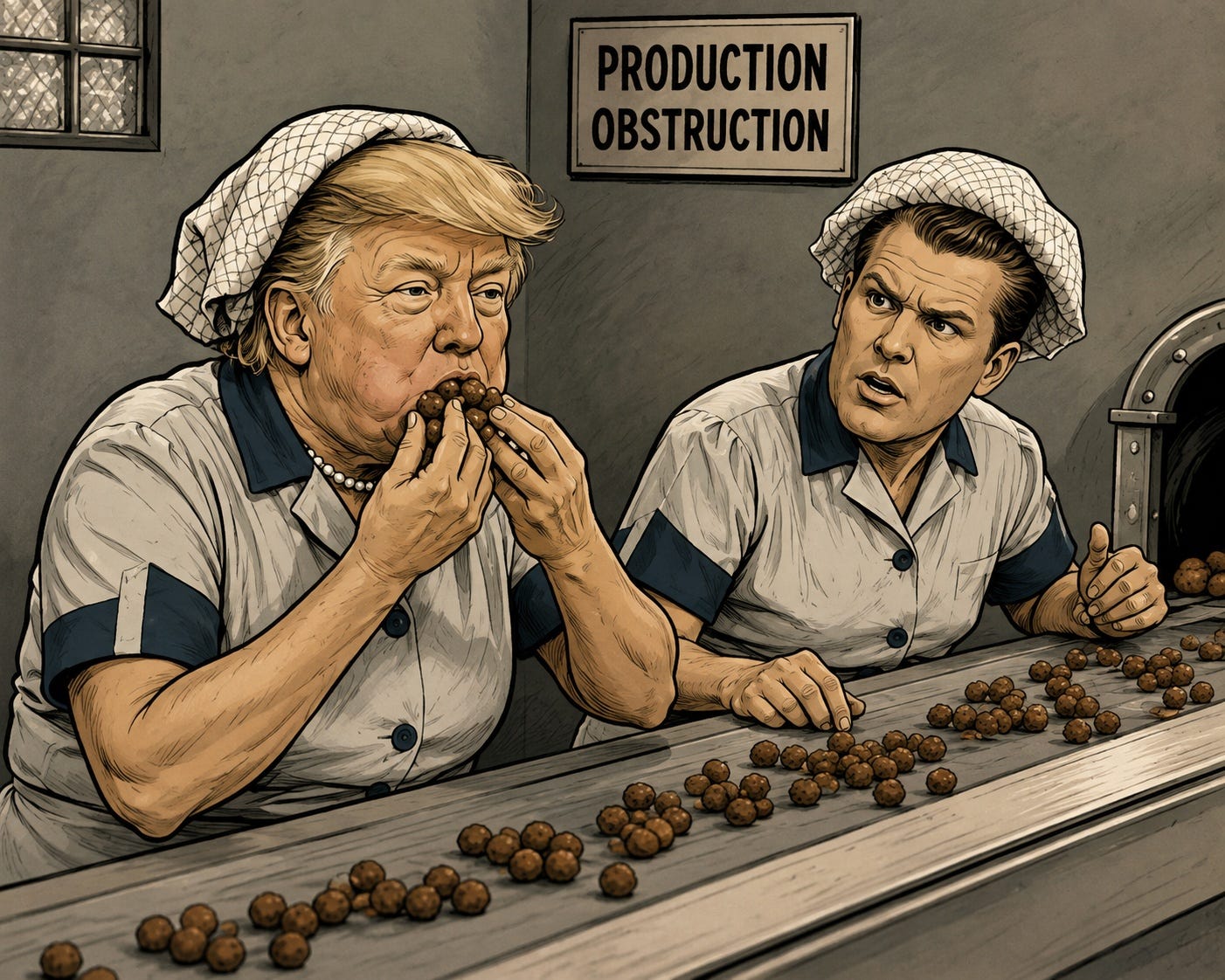
Production Obstruction
This is Part I of a two-part series examining the history of the American industrial war machine and the structural factors driving the United States' current military production crisis.

Jon Kurpis is an elected official, writer, and entrepreneur dedicated to advocating for everyday citizens. Known for his independent mindset and principled approach, Kurpis is respected for holding those in power accountable. His background in government, policy, and geopolitics makes him a trusted voice on complex political and cultural matters. He is a Contributing Analyst for The Duran Daily. More of his work can be found on his Substack, kurpis.substack.com.
In my recent article published on The Duran Substack entitled It Starts with a C, the connection between President Trump’s July 3rd Mount Rushmore speech and the possibility of a military conflict between the United States and Cuba was examined. Among the issues explored was the prospect that the military-industrial complex may view Cuba as a future center for military production, given its inexpensive labor, available natural resources, and America’s need to expand its manufacturing capacity. An important related question that naturally follows, but was not addressed in that piece, is: Why does the United States have a military production problem in the first place? This 2 part series deep dives into that question and examines America’s military production history, the current crisis, the forces that bear responsibility for it, and what it all means for the country’s future.
Before we begin, it must be noted that I am not an expert in supply chains, logistics, or large-scale civilian or military manufacturing. At the same time, like most competent adults, I’m not an idiot. I’ve founded companies, currently serve as an elected official and as a historian, and am someone who has dedicated decades to the study of geopolitics and domestic political affairs. That said, it doesn’t take my background or a career in manufacturing or the armed forces to recognize that something is profoundly amiss with America’s military production capacity. The numbers simply don’t add up. This issue becomes even more concerning when one considers that the United States is on pace to spend in excess of 1 trillion dollars next year on defense related expenditures. It is difficult to believe that such an enormous sum can be flowing into the defense establishment while so little production seems to come out of it, especially when there is an obvious need to increase output. It’s even harder to reconcile this reality when one understands what the United States had been capable of a generation ago.
Military Production Throughout US History
When it comes to military production in the United States, there is an extensive historical record of how the nation’s defense industrial base has functioned. While no two conflicts have been the same, the United States has participated in enough wars, military operations, and kinetic engagements to provide a substantial body of knowledge from which to draw essential lessons. Before examining the issues facing today’s military industrial base, let’s briefly review these conflicts to establish a point of reference upon which to build.
American Civil War
The American Civil War was a dreadful conflict noted for death, destruction, and, on a positive note, the end of slavery in the United States. But beyond the well- known facts, the Civil War also was the first example of large-scale US military production that has any similarity to modern practices.
At the tip of the military industrial spear was the historic Springfield Armory. At its high point, the Springfield Armory produced around 1,000 rifles per day with other Northern factories accounting for an additional 500 guns per day as well. All in all, 1500 rifles manufactured per day by Union factories was an astonishing amount for the time. This figure isn’t even accounting for the hundreds of thousands of bullets also produced on a daily basis by Union factories during the war.
World War I
On April 6th, 1917, the United States of America officially entered WWI when Congress approved President Woodrow Wilson’s request to declare war on Germany. Although direct involvement in the first world war lasted less than two years, military industrial output was remarkable. Specifically, America was able to manufacture 14,000 aircraft, 20,000 aircraft engines, 1,000 merchant ships, thousands of military trucks and hundreds of thousands of artillery shells per month
When looked at critically, the most significant result of WWI for the Americans wasn’t a specific production record. It was the fact that the war resulted in the creation of the internal systems, standardizations, government-industry partnerships, contracting policies, and assembly-line manufacturing that made future meteoric production numbers possible.
World War II
One day after the Japanese sneak attack bombing of Pearl Harbor on December 7th, 1941, the United States entered WWII by officially declaring war on Japan. And with that, America began its transformation from an economy still recuperating from the Great Depression into the largest industrial military machine the world has ever known.
During the course of the war, American defense manufacturing numbers were off the charts. US factories produced approximately:
4500 naval vessels
60,000 landing craft
86,000 tanks
297,000 aircraft
2.4 million military trucks
Millions of machine guns
Millions of artillery pieces
Millions of tons of ammunition
And at the zenith of WWII military production, the United States was generating roughly:
170 aircraft per day
50 tanks per day
8000 military vehicles per day
Such an unprecedented level of production did not happen by accident. It was the result of clever thinking and an enormous concentrated effort by American corporations and the people themselves. While there is no shortage of manufacturing achievements during these years, below are a few examples to help illustrate the scale of what was accomplished.
Ford “Willow Run” Factory & the B-24 Bomber
The B-24 bomber, made up of over 1 million parts, was one of the most complex machines of the day. To aid in its production, Ford unleashed a gargantuan mile long factory named Willow Run that adapted car assembly-line methods to aircraft production. The results were truly unbelievable. By 1944, Willow Run was putting out a new B-24 bomber every 63 minutes.
In order to achieve these astounding numbers, 42,000 workers took part in the effort. This included thousands of women, known as “Rosie the Riveters”, whose efforts were critical in making this level of production possible.
Kaiser Shipyards
While never having built a ship prior to launching his operation, Henry Kaiser revolutionized American shipbuilding during World War II. Over the course of the war, the Kaiser Shipyards produced hundreds of Liberty and Victory ships.
This remarkable performance was made possible by a workforce of more than 250,000 people of all sexes, races, and nationalities. As was the case with other manufacturing facilities during the war, many workers had little or no previous industrial experience. To deal with this predicament, Kaiser invented new production strategies, including multiple shifts to cover all hours of the day, extensive prefabrication, and training systems that enabled new workers to become productive very quickly.
Manhattan Project
The Manhattan Project was not a military production achievement in the traditional sense, but it was every bit as remarkable as these other examples in terms of scale and complexity. Costing tens of billions of dollars in today’s money and employing more than 130,000 people at its height, the Manhattan Project required the construction of secret cities such as Los Alamos, where many workers had no understanding of what they were helping to build.
The project also required power plants, serious quantities of copper and silver, scientific innovation, and an industrial infrastructure unlike anything that had been previously built. Ultimately, this concerted integration of science, military technology, and manufacturing culminated in the development of the world’s first atomic bombs.
Join The Duran Community.
Subscribe and Support The Duran!
The Korean War
While not without its problems, the Korean War still demonstrated that America’s enormous military industrial capacity built during WWII was not a fluke. At the start of the conflict, equipment shortages were experienced, but these problems were tackled head-on and mostly fixed within a year. After those initial hiccups, US military production expanded to the level where the United States was able to meet its own requirements and also supply its allies.
The War in Vietnam
Although the Vietnam War is now looked at as a military disaster, at the time it served to showcase the depth of American defense industrial power. This is substantiated by the fact that the United States was able to outfit more than half a million troops across the world with relative ease. Furthermore, the war also resulted in a massive supply of helicopters, aircrafts, ammo, and other equipment needed in battle. In terms of the end result, military industrial capacity was not a major factor. Instead, the end results were shaped by domestic political constraints and an opponent who was willing to endure extraordinary losses over a prolonged period of conflict.
Reagan Administration
President Reagan’s two terms in office marked the final years of the Cold War. During this period, the United States reached an unprecedented level of military superiority. Decades of preparation for a war with the USSR had resulted in extensive investments in both R & D and manufacturing, allowing the United States to create stealth technology, precision-guided missiles, nuclear powered subs, aircraft carriers and advanced satellite surveillance on a scale unmatched by any other nation.
Post Cold War Shift
When the Cold War finally ended, US military strategy shifted away from maintaining large conventional inventories and toward an accumulation of smaller numbers of sophisticated weapons systems. The goal focused on improving battlefield capability and operational efficiency while reducing overall costs. However, this shift came at the expense of production capacity and this model has defined the American defense industry ever since.
First Gulf War
The First Gulf War kicked off in early 1991 and was an American military logistical masterclass. Heavily reliant on massive stockpiles of munitions and equipment accumulated during the Cold War, the conflict was an exhibition of US investment in defense technology, training, production, and planning.
War in Afghanistan
The war against the Taliban in Afghanistan demonstrated many of the strengths of American military including intelligence gathering, early drone technology and precision guided weapon strikes. And if nothing else, the United States exhibited that it was able to sustain military operations for a period of 20 years. At the same time, the war exposed the increasing difficulty of replacing specialized military equipment, offering an early indication of the defense industrial challenges that would become more significant in the future.
Second War in Iraq
From a military perspective, the Iraq War of 2003 is known for both its rapid conventional victory while also exposing important shortcomings. Replenishing equipment was more difficult than the Pentagon expected, and there was insufficient planning for maintaining security after the invasion. Production capacity itself was not yet the critical issue it is today, but the war revealed early signs of the challenges that would become much more apparent in the years ahead.
Present Day Military Production
Depite historic production prowess, the United States military currently finds itself in a position where it has insufficient equipment and munitions. This includes a dwindling inventory of Patriot interceptors, 155mm artillery shells, precision-guided munitions, and air defense systems. Furthermore, the US military has a very limited surge capacity, exacerbated by single-source suppliers and a modern industrial base that was not designed to sustain the massive consumption rates associated with high-intensity conflicts over long periods of time.
These issues are further compounded by shortages of critical materials. While there tends to be a focus on America’s reliance on rare earths, that is only one part of the problem. The United States also faces shortages of rocket motors, explosives, propellants, radar parts, micro-electronics, and various other essential components.
Even if the Pentagon were to fully commit to addressing these shortcomings, considerable obstacles would remain in their way. Defense related manufacturing is constrained by a shortage of skilled and unskilled workers, multi-year timelines to build or expand production facilities, maintenance backlogs, and next to no allied production capacity. Collectively, these factors make it nearly impossible to replenish current inventories, sustain prolonged operations, or rapidly expand production in the near future.
Conclusion
From the Civil War all the way to the present day, the United States military has repeatedly confronted a wide range of production challenges. These experiences revealed both successful approaches and costly mistakes. That said, this massive collective body of military production know-how should, in theory, have shaped contemporary defense planning in such a way that the United States would not be in the position they find themselves in today.
Unfortunately, current US military production capacity is embarrassingly small by past standards and completely insufficient, as has been demonstrated by the ongoing wars in Ukraine and against Iran. Factually speaking, the United States military is woefully unprepared to subdue its enemies in a manner that was possible in the not-so-distant past.
The lack of US military production that we are witnessing is truly unprecedented and cannot be overstated. The gravity of the circumstances was best described by Alexander Mercouris in the July 27th episode of The Duran. Mercouris stated:
We are actually at an extraordinary moment in modern history, all the way back to the American Civil War of the 1860s. I do not remember any situation where the United States has had to stop and pause a war because it has run out of weapons. This is an extraordinary thing. If you remember previous American wars, they were always fought by the United States with a superabundance of weapons. Now, after a few months of fighting, they have been exhausted by Iran.
In Part Two of “Production Obstruction”, we will examine some lesser-known, yet highly consequential production factors that have contributed to the position in which the United States now finds itself. After analyzing these problems, we will then explore the practical solutions that, while unlikely to provide an immediate fix, will help prevent similar challenges from occurring in the future if meaningful reforms are implemented.
As always, I thank you for your continued support and readership.
Until next time,
Jon Kurpis
DISCLAIMER: This article is published strictly in my personal capacity and reflects only my individual views and analysis. Nothing herein should be interpreted as an official statement, communication, or policy position associated with my role as an elected official, any municipality, governmental authority, political party, or affiliated public institution. Furthermore, the perspectives expressed do not necessarily reflect the views or positions of The Duran.
Thanks for Reading!
Feel Free to Share, Comment and Subscribe!
Having worked in various manufacturing roles my whole life, I can say a major reason for the lack of skilled workers right now is due to the tremendous outsourcing that took place during the mid to late 90s and beyond. The young people at that time naturally did not pursue manufacturing careers, since there were less and less opportunities available as outsourcing increased.
I am glad scAmerica is out of weaponry, as no one has attacked us except the stupid super rich bankster hamster slime